Famous Zhong Kui Temples Across China
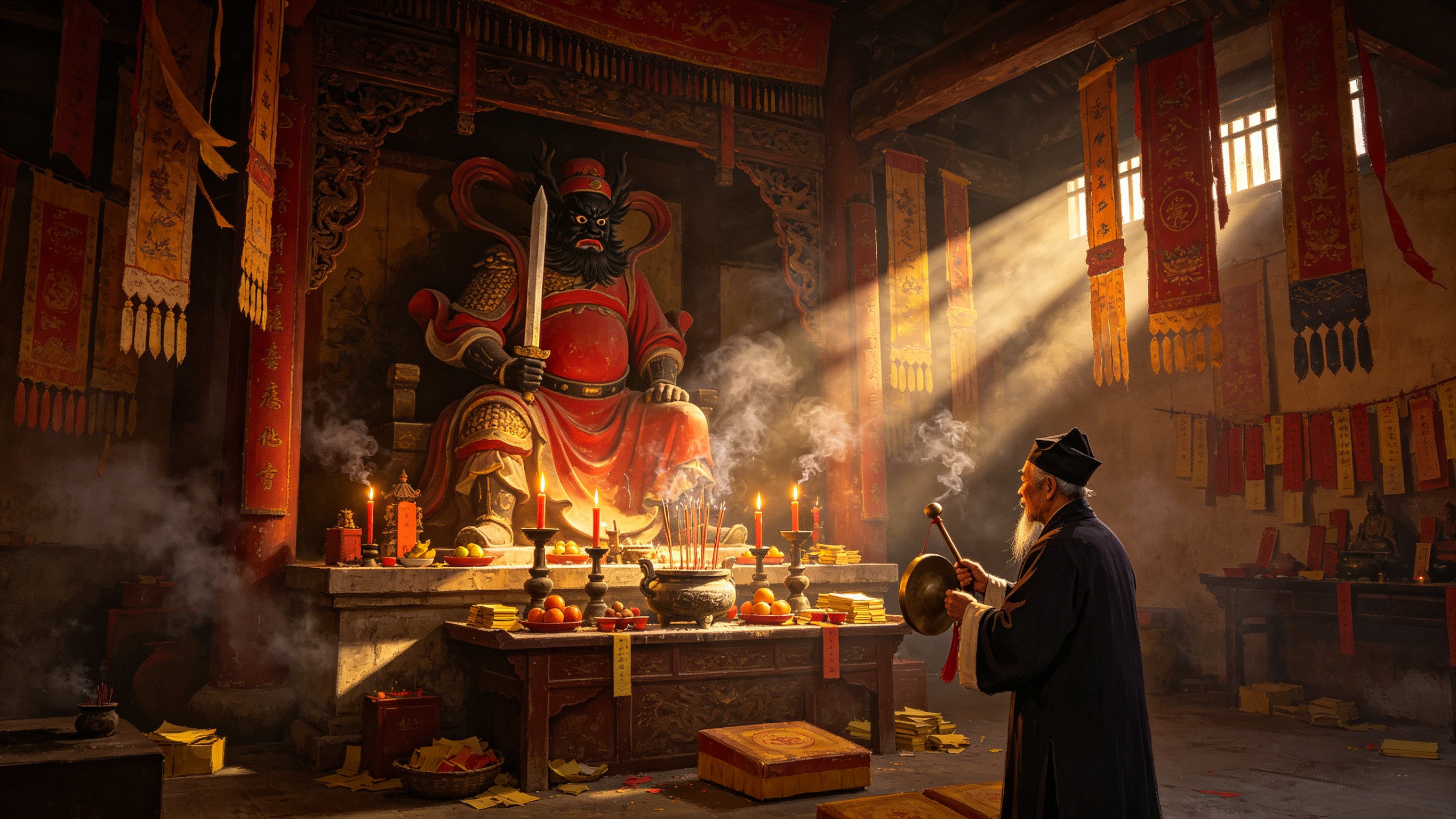
Mount Zhongnan Temple (终南山钟馗庙)
Perched on the slopes of Mount Zhongnan (终南山), the very mountain where Zhong Kui was born according to legend, this temple is the most revered pilgrimage site for the Demon Queller. Located near modern-day Xi'an in Shaanxi Province, the temple complex dates back to the Tang Dynasty, though the present structures reflect later rebuilding efforts over the centuries. Pilgrims climb the winding stone path, passing ancient pine trees whose branches are festooned with red prayer ribbons, each one a plea for protection.
Inside the main hall stands a towering statue of Zhong Kui, his eyes bulging with fierce intensity, his red robe flowing, his right hand gripping the legendary Seven-Star Sword. Incense smoke curls continuously before the statue as devotees bow three times, pressing their foreheads to the cushion. The temple is especially crowded during the Dragon Boat Festival, when thousands gather to participate in the grand exorcism ceremony. Many visitors bring small effigies of demons to be symbolically "slain" before the shrine.
The Xi'an Zhong Kui Temple
Within the ancient capital of Xi'an, a city that served as the Tang Dynasty imperial seat, stands a temple dedicated to the emperor's dream-born savior. This temple is notable for its exquisite murals depicting the complete Zhong Kui narrative — from his examination failure and suicide to his dream appearance before Emperor Xuanzong and his subsequent deification by the Jade Emperor. Local tradition holds that this temple was built on the very spot where Emperor Xuanzong ordered Wu Daozi to paint the first Zhong Kui portrait. A stone stele in the courtyard, inscribed with Tang Dynasty characters, recounts the story.
Lesser-Known Shrines & Local Temples
Beyond these major centers, Zhong Kui shrines can be found in virtually every Chinese province. In Fujian, coastal communities maintain temples where fishermen pray to Zhong Kui before setting out to sea, believing he protects them from water ghosts and maritime demons. In Taiwan, the Zhong Kui Temple in Taichung attracts thousands during Ghost Month (鬼月), when the gates of the underworld open and spirits roam the earth. Rural villages across southern China often maintain small earth-and-wood shrines at the village entrance, housing a crude but beloved image of Zhong Kui, his face painted in bold red and black stripes. These humble shrines, often no larger than a doghouse, represent the grassroots layer of Zhong Kui worship — faith that requires no grand architecture, only sincere devotion.
The Dragon Boat Festival Connection
Of all the annual festivals in the Chinese calendar, none is more intimately associated with Zhong Kui than the Dragon Boat Festival (端午节, Duanwu Jie), observed on the fifth day of the fifth lunar month. This connection is ancient and deeply practical: the fifth lunar month was traditionally considered the most dangerous time of the year, when yin energy peaked, pestilence spread, and evil spirits grew bold. The Dragon Boat Festival was, at its core, a festival of exorcism and purification — and Zhong Kui was its patron deity.
Hanging the Demon Queller's Image
The central ritual of Zhong Kui worship during Duanwu involves hanging his portrait on the front door, often alongside sprigs of mugwort (艾草) and calamus (菖蒲). The mugwort's pungent aroma drives away physical pestilence, while Zhong Kui's fearsome image drives away spiritual evil working in tandem, the herbal and the divine. Families take care to hang the portrait at precisely midday, when yang energy is strongest. The Zhong Kui image used for Duanwu is distinct: he is typically shown wearing an official's hat adorned with a small golden figure of the Heavenly Dog (天狗), a demon-eating celestial hound, and holding a gourd that contains captured evil spirits.
The Five Poisonous Creatures
The Dragon Boat Festival is also the time when the Five Poisonous Creatures (五毒) — the snake, centipede, scorpion, lizard, and toad — emerge from hibernation and pose a threat to humans. In Chinese folk religion, these five creatures are not merely physical pests but manifestations of baleful spiritual energy. Zhong Kui is believed to have absolute power over them. Many Duanwu Zhong Kui prints depict him standing triumphantly over all five creatures, his sword pinning the serpent, his foot crushing the scorpion. Some households burn a special "Five Poisons Talisman" (五毒符) inscribed with Zhong Kui's name, scattering the ashes at the threshold to create a year-round protective barrier. The connection between Zhong Kui and the Five Poisons is so strong that many Chinese folk paintings (年画) of the Demon Queller sold during this season include the five creatures somewhere in the composition, even if only as tiny decorative elements in the border.
Daoist Exorcism Rituals
Within the vast corpus of Daoist ritual practice, Zhong Kui holds a uniquely prominent place. Daoist priests — particularly those of the Celestial Masters tradition (天师道) — have developed elaborate ceremony protocols specifically for invoking Zhong Kui's power. These rituals, known collectively as Zhong Kui Ke Yi (钟馗科仪), are among the most dramatic and visually spectacular in the Daoist repertoire.
The Zhong Kui Dance (跳钟馗)
Perhaps the most recognizable form of Zhong Kui worship in public performance is the Zhong Kui Dance, known as Tiao Zhong Kui (跳钟馗). Performed by trained ritualists — often Daoist priests or folk artists who have inherited the tradition through family lineages — the dance is part exorcism, part theater, and part spiritual possession. The performer wears an elaborate costume: a flowing red robe, black boots, a false beard, and most importantly, a painted mask or facial makeup that transforms him into the Demon Queller incarnate. He wields a sword in one hand and a talisman in the other, moving through a choreography of battle — lunging, slashing, stomping, and glaring. Drumbeats drive the rhythm, cymbals crash at moments of climax, and the air fills with the smoke of burning incense and talismanic paper. The dance is believed to cleanse the space of all malevolent presences, whether in a temple courtyard, a village square, or a private home during a house-blessing ceremony.
During formal exorcism rituals, the Daoist priest first purifies himself through fasting and meditation, then constructs a ritual altar (法坛) adorned with Zhong Kui's image, five-colored flags, and offerings of rice, wine, and fruit. He writes talismans (符箓) on yellow paper using cinnabar ink, each talisman inscribed with Zhong Kui's name and seal. These talismans are then activated through chanting and mudras (ritual hand gestures) before being burned or affixed to doorways. The climax of the ritual is the Summoning of the Demon Queller (请钟馗), when the priest calls upon Zhong Kui to descend into the ritual space, his presence made manifest by a sudden gust of wind, the flickering of candle flames, or the trembling of the talisman paper. The ritual ends with the priest scattering rice and beans to feed hungry ghosts, followed by a final, explosive blast of the horn to seal the purification.
The Zhong Kui Birthday Festival
While the Dragon Boat Festival is the most widespread Zhong Kui observance, many communities celebrate his birthday festival on the twenty-ninth day of the seventh lunar month (though some traditions place it on the ninth day of the ninth month). This festival is observed with particular fervor at the Mount Zhongnan Temple, where the celebration lasts for three days and draws pilgrims from across northern China.
The birthday festivities begin at dawn with the ceremonial washing of Zhong Kui's statue — a reverent act in which the temple abbot wipes the statue with water infused with pomelo leaves, believed to possess purifying properties. Devotees then offer a grand feast of steamed buns, roast chicken, fruits, and rice wine, arranged before the main altar. Incense sticks as thick as a child's arm burn continuously, their fragrant smoke rising like prayer. Paper money (冥纸) is burned in massive furnaces, sending wealth to the spirit world for Zhong Kui's use. Throughout the day, opera troupes perform Zhong Kui operas, including the perennial favorite Zhong Kui Marries Off His Sister (钟馗嫁妹). The festival culminates in a procession through the local town, with an ornate sedan chair carrying the temple's Zhong Kui statue, followed by devotees carrying banners, beating drums, and setting off firecrackers to drive away any lingering evil spirits. The Zhong Kui Dance is performed at multiple stops along the route, ensuring every household receives the Demon Queller's blessing.
Folk Practices and Household Worship
Beyond the grand temple ceremonies and festival processions, Zhong Kui worship is most vibrantly alive in the daily practices of Chinese households. Across China — and in Chinese communities worldwide — families maintain simple but meaningful devotional practices that keep the Demon Queller present in their daily lives.
The Household Altar
Many traditional Chinese homes maintain a small altar dedicated to Zhong Kui, often in the entrance hall or facing the front door. The altar is simple: a framed print or statue of Zhong Kui, a small incense burner, and perhaps a cup of tea or water as an offering. The image of Zhong Kui used for household worship is typically a New Year print (年画) purchased fresh each year, as the old one is burned during the Dragon Boat Festival. The Zhong Kui print should ideally face the main entrance, so that his fierce gaze falls upon anyone who enters. Proper placement is considered crucial: the image must not be placed too high (it would appear to be looking over people's heads) nor too low (it would be disrespectful). Eye level is ideal, allowing a direct encounter between the deity and the supplicant.
When to Pray
Devotees typically light incense before Zhong Kui's image in the morning and evening, particularly during the Ghost Month (seventh lunar month), when the boundaries between the living and the dead grow thin. Specific prayers are offered for protection during travel, before moving into a new home, during illness, and after unsettling dreams. Housewarming rituals often include inviting a Daoist priest to perform a simplified version of the Zhong Kui exorcism, ensuring the new dwelling is free of any spiritual residue from previous occupants. Many families also place a small Zhong Kui talisman above the bed of a newborn child, believing the Demon Queller's protection is especially important for vulnerable infants who have not yet developed strong life-force (阳气).
Modern Adaptations
In contemporary China, Zhong Kui worship has adapted to modern life. Smartphone apps now offer digital Zhong Kui talismans that can be displayed on phone screens. Online forums connect devotees who share photos of their home altars and discuss proper ritual procedures. Some Daoist temples now livestream their Zhong Kui exorcism ceremonies during the Dragon Boat Festival, allowing overseas Chinese to participate virtually. Yet despite these modern innovations, the core of Zhong Kui worship remains unchanged: a sincere belief that the wronged scholar from Mount Zhongnan, armed with his sword and his uncompromising righteousness, still hunts demons and protects the faithful. Whether the offering is a stick of incense or a digital prayer, the devotion behind it is the same that has sustained his worship for over a thousand years.