Zhong Kui's role as the Demon Queller — the supreme ghost hunter of the Chinese spirit world — would be impossible without his sacred arsenal. Each weapon in his possession was either bestowed by celestial authority, forged through Daoist ritual, or imbued with the power of Heaven itself. Together, they form a complete toolkit for combating every variety of supernatural evil: from wandering hungry ghosts to ancient demon lords. Understanding these weapons is essential to understanding how Zhong Kui operates and why his methods have been revered for over a thousand years.
The weapons of Zhong Kui are not merely instruments of destruction. Each one serves a specific spiritual purpose. Some bind, some banish, some imprison, and some protect. In the hands of the Demon Queller, they become extensions of his righteous will — tools of justice in a world where the boundary between the living and the dead is perpetually threatened. Below, we examine each weapon in full detail, exploring its origin, its power, and its role in Zhong Kui's eternal mission.
The Seven-Star Ghost-Slaying Sword 七星斩鬼剑
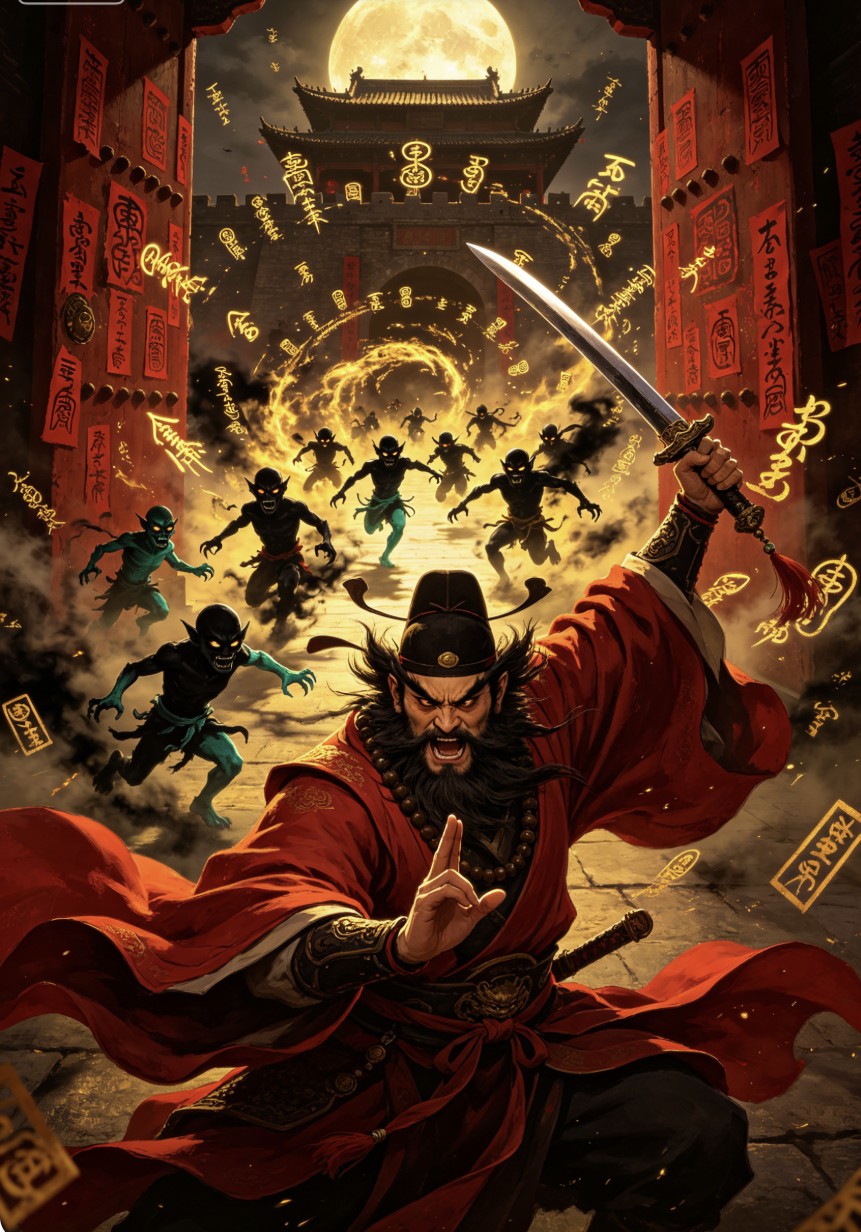
The Seven-Star Ghost-Slaying Sword (Qixing Zhan Gui Jian) is Zhong Kui's primary weapon and the most iconic symbol of his authority as the Demon Queller. Forged by Daoist masters in the sacred mountains of Longhu Shan (Dragon Tiger Mountain), this straight-bladed sword is engraved with the seven stars of the Big Dipper constellation (Beidou Qixing) along its full length. In Daoist cosmology, the Big Dipper is the seat of celestial power — it governs fate, controls the turning of the seasons, and commands the armies of Heaven. By carving these seven stars into his blade, Zhong Kui's sword becomes a direct conduit to the authority of the celestial realm.
The sword's primary power is its ability to cut through both physical flesh and spiritual essence. Ordinary weapons pass through ghosts and spirits without effect — the incorporeal dead cannot be harmed by mortal steel. But the Seven-Star Sword is forged with spiritual iron and tempered in sacred rituals that imbue it with the power to sever the ethereal bonds that anchor evil spirits to the mortal world. When Zhong Kui strikes a demon with this blade, it does not merely wound the creature — it severs its connection to existence itself, dispersing the malevolent energy that gives it form.
According to tradition, the sword was a gift from the Jade Emperor himself, delivered to Zhong Kui by celestial messengers after his divine appointment as Demon Queller. The blade is said to have been forged from a fragment of a shooting star that fell from the heavens, its metal already infused with celestial energy. The hilt is wrapped in red silk cord — the color of life and protection — and adorned with five ancient coins (wudi qian) threaded through the pommel, each representing one of the five directions of cosmic power: north, south, east, west, and center.
In traditional iconography, Zhong Kui is almost always depicted holding this sword in his right hand, often raised above his head in a striking pose. The blade gleams with an otherworldly light in paintings, and when he fights, the seven stars are said to glow with increasing intensity — brighter means more demons nearby. When the sword strikes true, it does not draw blood but rather releases a burst of golden light that purifies the surrounding space, banishing all residual negative energy for miles around.
The sword also serves a symbolic purpose beyond combat. In Chinese ritual tradition, the Seven-Star Sword is used by Daoist priests during exorcism ceremonies to draw protective circles, cut through malevolent qi, and command spirits to obey. Zhong Kui's possession of this blade ties him directly to the Daoist exorcist tradition and reinforces his role as the supreme celestial authority in matters of ghostly subjugation. The blade is both weapon and badge of office — a symbol of the Heaven-granted power to judge and execute evil spirits.
The Cinnabar Brush 朱砂笔
The Cinnabar Brush (Zhusha Bi) is perhaps the most distinctive weapon in Zhong Kui's arsenal — a writing instrument that is also a weapon of immense spiritual power. At first glance, it appears to be an ordinary scholar's brush, similar to the ones Zhong Kui would have used during his years of study for the imperial examinations. But this brush is charged with the power to inscribe living talismans that bind, banish, or destroy evil spirits with every stroke.
The brush's power lies in its ink, which is made from cinnabar (zhusha) — a bright red mercury sulfide mineral that has been central to Chinese alchemy, medicine, and spiritual practice for millennia. In Chinese tradition, cinnabar is believed to be intrinsically toxic to evil spirits. The mineral's bright red color — the same hue as lifeblood and the rising sun — represents yang energy, vitality, and the force of life itself. Evil spirits, being creatures of yin, darkness, and decay, are repelled and harmed by contact with cinnabar in any form.
When Zhong Kui dips his Cinnabar Brush into the inkstone and begins to write, the characters he traces glow with a fiery red light. Each stroke is a command spoken in the language of Heaven — the script of the celestial bureaucracy that governs the spirit world. By writing these characters into the air or onto special talisman paper, Zhong Kui creates binding contracts and commands that spirits must obey. A single stroke of the Cinnabar Brush can immobilize a minor ghost; a full talisman can banish an entire legion of demons.
The Cinnabar Brush is particularly effective because it operates on multiple levels simultaneously. On a physical level, the cinnabar ink creates a visible barrier that ghosts cannot cross — similar to the protective circles drawn in Daoist rituals. On a spiritual level, the characters themselves are living commands that echo through the spirit world, calling upon celestial authorities to enforce the Demon Queller's decrees. And on a symbolic level, the act of writing with the brush reasserts Zhong Kui's identity as a scholar of the highest order — a reminder that his true power comes from knowledge and righteousness, not brute force.
The brush is said to have been given to Zhong Kui by Wenchang Wang, the Chinese god of literature and scholarship, who recognized in the wronged scholar a kindred spirit. The brush's handle is carved from peachwood (taomu), another substance traditionally used in Chinese exorcism practices. The bristles are made from the hair of a white fox — a creature associated in Chinese folklore with both cunning and spiritual sensitivity. Every element of the Cinnabar Brush is chosen for its spiritual properties, making it a masterwork of ritual weaponry.
In practice, Zhong Kui uses the Cinnabar Brush in several ways. He may draw talismans on yellow paper to be posted on doors and walls, creating permanent protective wards. He may write commands directly into the air, where they hang as glowing characters before slamming into a demon with binding force. He may sign his name on a judgment that condemns a particularly dangerous spirit to eternal imprisonment. Or he may simply touch the brush to a demon's forehead, leaving a cinnabar mark that seals its power and renders it helpless.
The Demon-Binding Talismans 镇鬼符
The Demon-Binding Talismans (Zhen Gui Fu) are the written instruments of Zhong Kui's authority — yellow paper slips inscribed with cinnabar characters that carry the binding power of celestial law. Also simply called Fu talismans (符咒), these are among the most ancient and versatile tools in the Chinese spiritual tradition, and Zhong Kui is considered the supreme master of their use. Every talisman he writes is a legally binding contract in the courts of Heaven, enforceable by the full power of the celestial bureaucracy.
The construction of a demon-binding talisman follows strict ritual rules that have been preserved for centuries. The paper must be yellow — the imperial color, representing the authority of Heaven and the central direction. The ink must be cinnabar red, carrying the yang energy that repels all yin spirits. The characters must be written in a specific sequence and with a specific intention, starting from the top and moving downward without interruption. A single mistake in the calligraphy renders the talisman powerless, which is why Zhong Kui's perfect scholar's hand makes him the ideal talisman-writer.
Each character in a demon-binding talisman is a command in the language of Heaven — not ordinary Chinese writing but a sacred script that spirits are compelled to obey. Common characters include "bind" (缚), "seal" (封), "banish" (驱), "kill" (杀), and "command" (敕). Together, they form a legal sentence that judges and condemns the target spirit. When Zhong Kui completes a talisman, he seals it with his personal chop (stamp), marking it as an official decree of the Demon Queller's office.
The use of talismans in Chinese culture predates Zhong Kui by centuries, but his legend cemented their place in popular practice. Before Zhong Kui, talismans were primarily used by Daoist priests in formal ritual contexts. After his story spread, ordinary people began hanging talisman-inspired images on their doors and windows, hoping to invoke the Demon Queller's protective power. The tradition of posting Spring Festival couplets on red paper during Chinese New Year is directly connected to this talisman tradition — the red paper and black or gold characters are a secular continuation of the protective talisman practice.
Zhong Kui is especially famous for his use of a specific talisman called the "Zhong Kui Protective Fu" (钟馗镇宅符), a complex arrangement of characters that wards all evil from a household. This talisman combines the character for "Zhong" (钟), the character for "Kui" (馗), and the character for "command" (敕) in a stylized arrangement that is as much artwork as ritual object. Copies of this talisman have been found in archaeological excavations dating back to the Song Dynasty, demonstrating the enduring popularity of Zhong Kui's talismanic magic.
Beyond their protective function, the talismans also serve as a communication system within the spirit world. When Zhong Kui writes a talisman commanding a particular demon to be bound, the command is transmitted instantly through the spiritual network that connects all celestial authorities. Other gods, spirit soldiers, and even the infernal judges of Diyu (the Chinese underworld) can read and enforce Zhong Kui's talismanic commands. This makes his talismans far more than simple charms — they are administrative instruments of celestial governance.
The Spirit-Gathering Gourd 收妖葫芦
The Spirit-Gathering Gourd (Shou Yao Hulu) is one of the most fascinating weapons in Zhong Kui's arsenal — a humble dried gourd that possesses the power to suck in and imprison evil spirits. Unlike the sword, which destroys spirits, the gourd captures them alive (so to speak), holding them in an extradimensional prison from which there is no escape. This makes it the weapon of choice when Zhong Kui encounters a spirit that he wishes to interrogate or a demon whose crimes warrant eternal imprisonment rather than annihilation.
The gourd (hulu) has been a powerful symbol in Chinese culture for thousands of years. Its shape — two spheres connected by a narrow waist — represents the union of Heaven and Earth, and its hollow interior is seen as a microcosm of the universe itself. Daoist immortals are frequently depicted carrying gourds that contain magical elixirs, miniature worlds, or captured demons. The most famous of these is Taishang Laojun (太上老君), the Lord Lao, whose gourd contains the elixir of immortality. Zhong Kui's gourd is said to be a gift from Taishang Laojun himself, passed down from the highest reaches of the celestial realm.
When Zhong Kui uses the gourd, he first identifies the demon or evil spirit he wishes to capture. He then uncorks the gourd and points its opening toward the target while reciting a binding incantation. The gourd emits a powerful suction force that only affects supernatural beings — ordinary humans feel nothing more than a gentle breeze. The demon, regardless of its power, is drawn inexorably into the gourd's mouth, shrinking as it approaches until it disappears inside. Zhong Kui then corks the gourd, and the demon is trapped for eternity unless he chooses to release it.
The interior of the Spirit-Gathering Gourd is not a simple hollow space but an infinite dimensional pocket created by Taishang Laojun's alchemical arts. Within the gourd exists a vast, featureless void where time does not pass and no energy can be gathered. Demons trapped inside cannot communicate with the outside world, cannot gather strength, and cannot escape. Many of the most dangerous spirits in Chinese mythology — those too powerful to be killed with the sword — are said to be imprisoned within Zhong Kui's gourd, their malevolent influence neutralized for all eternity.
The gourd also serves a more benign purpose. On occasion, Zhong Kui uses it to temporarily contain spirits that he intends to rehabilitate. Unlike some celestial enforcers who destroy without mercy, Zhong Kui is known to show compassion to spirits who were not truly evil but merely misguided or suffering. He may capture such spirits in his gourd, carry them to a place of purification, and release them after they have been cleansed of their negative attachments. This reflects the deep compassion that underlies even the most fearsome aspects of Zhong Kui's character.
The Red Official Robe 大红官袍
The Red Official Robe (Da Hong Guan Pao) is the garment that Zhong Kui wears in every traditional depiction — a flowing crimson robe that identifies him as a scholar-official of the highest rank. But this garment is far more than ceremonial regalia. The robe is blessed with protective spells and imbued with the power of the red color itself, which in Chinese tradition is the most powerful ward against evil in the entire chromatic spectrum. It is simultaneously Zhong Kui's uniform, his armor, and his banner of authority.
The significance of the color red (hong) in Chinese culture cannot be overstated when it comes to spiritual protection. Red is the color of fire, life, the sun, and yang energy. It is the color of good fortune, prosperity, and joy. In Chinese weddings, brides wear red. During Chinese New Year, red envelopes are given as gifts. And most importantly for our purposes, red repels evil spirits — this is why temple doors are painted red, why children wear red clothes during festivals, and why Zhong Kui's robe is the exact shade of fresh cinnabar. Evil spirits, being creatures of darkness and cold, cannot bear the sight of red and flee from it.
But the robe is not just red — it is specifically a scholar-official's robe (guanpao), the garment that Zhong Kui would have worn had he been allowed to take his rightful place in the imperial court. The robe features a round collar, wide sleeves, and a black belt with a gold buckle. In some depictions, the robe is embroidered with golden patterns — clouds, bats (symbols of good fortune), or the character for "longevity" (寿). The robe identifies Zhong Kui as a member of the civil bureaucracy, not the military, which is an important distinction in Chinese mythology.
The robe's protective properties are activated simply by wearing it. When Zhong Kui approaches a haunted location, the red fabric begins to glow with a warm, pulsing light that drives lesser spirits into hiding. Demons who look directly at the robe feel their eyes burn as if staring at the sun. The robe also protects Zhong Kui himself — any curse or spiritual attack directed at him must first pass through the robe's protective barrier, which absorbs and neutralizes malevolent energy. In this sense, the robe functions like a shield woven from light itself.
According to some versions of the legend, the robe was a gift from Emperor Xuanzong himself, bestowed after the emperor's dream in which Zhong Kui saved him from the demon. The emperor ordered the finest silk weavers in the capital to create a robe fit for the divine protector of the Tang Dynasty. The robe was then blessed by Daoist priests in a seven-day ceremony at the Temple of the Highest Purity. When the ceremony was complete, the robe was burned in a ritual fire — and appeared instantly on Zhong Kui's spiritual body, a gift from both the mortal emperor and the celestial realm.
In all, the Red Official Robe represents the merging of Zhong Kui's two identities: the scholar he was in life and the god he became in death. The robe is a scholar's garment, reflecting his learning and his rightful place among the educated elite. But it is also a god's armor, radiating the power of Heaven itself. It reminds us that Zhong Kui's authority comes not from brute force but from his righteous character, his scholarly discipline, and his unwavering commitment to the cosmic order. He is, in every sense, a scholar who fights — and a fighter who thinks.
A Complete Spiritual Arsenal
What makes Zhong Kui's arsenal truly remarkable is not any single weapon but the complete system of spiritual warfare that the five weapons together constitute. The sword destroys. The brush commands. The talismans bind. The gourd imprisons. The robe protects. Together, they cover every possible contingency in the war against evil spirits. No demon, regardless of its power or nature, can resist all five weapons simultaneously. This is why Zhong Kui has never been defeated in combat — his arsenal leaves no weakness unguarded and no enemy unaddressed.
For those who study Chinese mythology, the weapons of Zhong Kui also offer a window into the broader cosmology of Daoist spiritual practice. Each weapon represents a different aspect of the tradition: the sword embodies Daoist martial arts and ritual, the brush embodies the power of sacred writing, the talismans embody the legal-administrative nature of the celestial bureaucracy, the gourd embodies the alchemical tradition, and the robe embodies the color-based symbolism that runs throughout Chinese culture. Understanding these weapons deepens one's understanding of Chinese civilization as a whole.
To explore Zhong Kui's story further, read about his tragic origins as a wronged scholar and his transformation into the Demon Queller, or witness his epic ghost-hunting battles against the most feared spirits in Chinese mythology. For a broader perspective on the celestial hierarchy, see our guides to Chinese mythology and the gods and deities of the Chinese pantheon.
For comparisons with other divine warriors, explore the arsenal of Guan Yu, the God of War, whose Green Dragon Crescent Blade is another legendary weapon in the Chinese pantheon, or learn about Erlang Shen's Heaven-Opening Halberd and his third eye. For more on the alchemical tradition that produced the Spirit-Gathering Gourd, visit Taishang Laojun, the Supreme Lord of Daoism and master of the Eight Trigrams Furnace. To understand the Buddha's connection to the spirit world and the broader cosmology of which Zhong Kui is a part, also see Buddha.