From the steps of the Tang palace to the throne of the ghost-hunting immortals — the tragic and triumphant birth of a demon queller.
Who Was Zhong Kui Before He Became a God?
Before becoming the legendary demon queller, Zhong Kui (钟馗) was a brilliant scholar of the Tang Dynasty who lived as a recluse on Zhongnan Mountain (终南山). He was renowned for his extraordinary intellect and mastery of the Confucian classics, but cursed with a grotesque appearance so shocking that it would seal his tragic fate. After earning the highest possible rank (zhuangyuan, 状元) in the imperial examination, he was stripped of his honor before the entire court because Emperor Xuanzong found his face repulsive. Rather than accept such injustice, Zhong Kui smashed his head against the palace steps and died. His righteous suicide set in motion a chain of events that would transform him from a wronged mortal into heaven's appointed Demon Queller of the Realm, with command over 80,000 ghost soldiers and the eternal duty to protect humanity from the forces of darkness.
The Scholar of Zhongnan Mountain
The story of Zhong Kui begins in the mist-shrouded peaks of Zhongnan Mountain (终南山), a range southwest of the Tang capital Chang'an that has long been associated with Daoist hermits, mystics, and reclusive sages. According to the earliest surviving accounts, compiled during the Song Dynasty, Zhong Kui was born sometime during the reign of Emperor Xuanzong (712–756 CE), the monarch who presided over both the golden age and the catastrophic decline of the Tang Dynasty.
From his earliest youth, Zhong Kui distinguished himself as a prodigy. He devoured the Confucian canon — the Four Books and Five Classics — with an appetite that astonished his teachers. His command of classical prose, poetry, and statecraft was unmatched among his peers. Neighbors and fellow scholars predicted a glorious future: here was a young man destined for the highest echelons of the Tang bureaucracy, perhaps even the office of Grand Chancellor.
But there was a shadow over his brilliance. Zhong Kui had been born with a face that startled even those who wished him well. Traditional descriptions paint a picture of startling ugliness: a broad, dark face with bulging eyes like copper bells, a thick, bristling beard that covered most of his features, a forehead as craggy as the cliffs of his mountain home, and a body as massive and intimidating as a black bear's. Some legends say he was born with horns beneath his skin, visible as bumps across his scalp. His voice was a thunderous roar that made children cry and adults flinch.
In a society that placed enormous value on a scholar's bearing and appearance — where imperial officials were expected to present a dignified, pleasing image to the court — Zhong Kui's face was a liability he could not overcome. Yet he believed, with the faith of the truly virtuous, that his intellect and character would speak louder than his appearance. He studied harder than any of his classmates, determined to prove that a man's worth lay in his mind and his heart, not in the shape of his nose or the set of his jaw.
"The ugliness of Zhong Kui's face was the beauty of his fate made visible — a warning to the world that judgment based on appearance is the cruelest form of blindness."
— Adapted from Qing Dynasty folk commentary
The Imperial Examination
The imperial examination system of Tang Dynasty China was one of the most rigorous meritocratic institutions in human history. Candidates spent years — often decades — memorizing the Confucian classics, composing poetry in prescribed forms, and mastering the art of political essay. The highest honor a candidate could achieve was zhuangyuan (状元), a title meaning "top scholar" or "champion," awarded to the single best performer in the palace examination conducted in the presence of the emperor himself. To become zhuangyuan was to be guaranteed a prestigious government post, immense wealth, and a secure place in history.
Zhong Kui descended from Zhongnan Mountain and traveled to the capital Chang'an — then the largest and most cosmopolitan city on earth, a metropolis of over a million people that stood at the eastern terminus of the Silk Road. He sat for the examinations alongside thousands of other hopeful scholars from across the empire. The tests were grueling, lasting days, requiring candidates to compose intricate essays on governance, morality, and classical texts from memory.
When the results were announced, Zhong Kui's name stood alone at the top. He had earned the zhuangyuan. The examiners were unanimous in their praise: his essays demonstrated a depth of understanding, a command of rhetoric, and a moral insight that surpassed every other candidate. For a brief, glorious moment, the wronged scholar of Zhongnan had achieved the dream of every educated man in China.
The palace examination ceremony was held in the grand hall of the imperial palace, with Emperor Xuanzong himself presiding from the Dragon Throne. Zhong Kui was called forward to kneel before the emperor and receive his honor — the jade tablet, the crimson robe, the golden seat among the empire's elite. It was the moment he had worked his entire life to earn.
But when Zhong Kui raised his head, the emperor saw his face.
The court historian's account does not record Emperor Xuanzong's exact words, but the outcome is seared into Chinese folklore: the emperor was so repulsed by Zhong Kui's appearance that he immediately rescinded the honor. "How can a man so hideous represent the Tang court?" the emperor is said to have declared. "What message would this send to foreign emissaries? What would the barbarians think when they see such a face at our court?"
The hall fell silent. The examiners, who had praised Zhong Kui's genius moments before, lowered their eyes. No one spoke in his defense. The meritocracy that had elevated him crumbled in an instant before the casual cruelty of imperial vanity.
The Emperor's Rejection
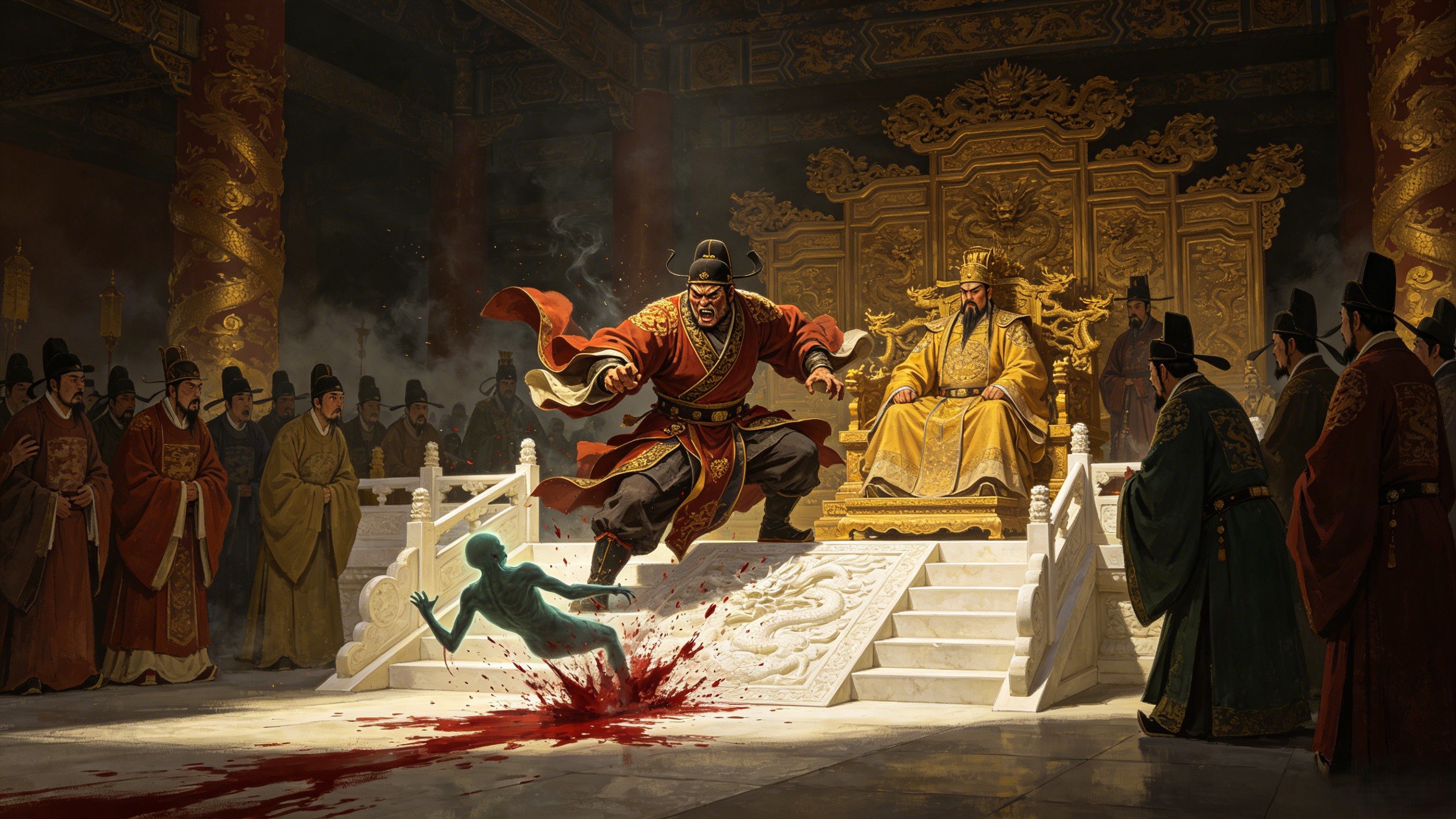
The tragic turning point — Zhong Kui's righteous suicide at the Tang court, the moment that set him on the path to becoming China's demon queller.
What happened next would define Zhong Kui's legend for all of Chinese history. As the guards moved to escort him from the hall, Zhong Kui did not plead. He did not weep. He did not beg the emperor to reconsider. Instead, the proud scholar rose to his feet and, with a voice that echoed through the marble halls, proclaimed his innocence and his integrity to the assembled court.
"I have committed no crime," he declared. "I have cheated no one. I have stolen nothing. I have mastered the classics, served my emperor with loyalty, and earned this honor through merit alone. If my face offends you, then let my blood wash away your displeasure."
Before anyone could stop him, Zhong Kui turned and ran toward the marble steps of the palace hall. With all the force of his wounded pride and righteous anger, he smashed his head against the stone steps. The crack of bone against marble silenced the court. The top scholar of the empire collapsed, his blood pooling on the very steps where he had knelt to receive his honor.
In later traditions, particularly those associated with Daoist hagiography, the Jade Emperor himself witnessed this act of righteous defiance from his celestial throne. The supreme ruler of heaven saw that Zhong Kui's suicide was not an act of weakness but of ultimate integrity — a man who would rather die than accept injustice. This would prove crucial to Zhong Kui's posthumous destiny.
The court was thrown into chaos. The emperor, shaken by the violent death he had caused, ordered Zhong Kui's body to be buried in a simple scholar's robe — a posthumous acknowledgment, perhaps, of the wrong that had been done. But no honors were restored. No apology was issued. The bureaucracy moved on, and the name of Zhong Kui was quietly erased from the examination records. The top scholar of his generation was consigned to an unmarked grave, remembered only by the few who dared to speak the truth.
This story resonates deeply with a core theme in Chinese culture: the tension between outward appearance and inner worth. The Chinese idiom "人不可貌相" (one cannot judge people by their appearance) finds its most powerful expression in the tale of Zhong Kui. His rejection by the emperor stands as an enduring critique of superficial judgment — a reminder that virtue, intelligence, and righteousness can dwell in the most unlikely vessels.
For more on how the Tang Dynasty's cultural and religious landscape shaped the mythology of its legendary figures, explore Chinese Mythology and its deep connections to imperial history. The story of Zhong Kui also parallels that of other Chinese deities who were once mortal, such as Guan Yu, the righteous general who became the God of War after his own unjust death.
The Emperor's Nightmare
The story might have ended with Zhong Kui's death — just another tragic footnote in the long annals of imperial injustice. But the tale takes a supernatural turn that reveals the hand of heaven at work.
In the years following Zhong Kui's suicide, Emperor Xuanzong's reign descended into turmoil. The An Lushan Rebellion (755–763 CE), one of the deadliest conflicts in human history, ravaged the empire, claiming millions of lives and nearly toppling the Tang Dynasty. The emperor who had once presided over the golden age of Chinese civilization — the patron of poets like Li Bai and Du Fu, the monarch whose court dazzled the world — became a haunted, paranoid figure, plagued by nightmares and illness.
One night, as the emperor lay in his palace bed, feverish and delirious, a demon appeared in his dreams. Unlike the refined ghosts of classical Chinese literature, this demon was a true e gui (饿鬼) — a hungry, malevolent spirit of the kind that preys on the living. It crept through the window, its skeletal fingers reaching for the emperor's throat, its hollow eyes gleaming with malice. The emperor tried to cry out, but no sound came. He tried to flee, but his body was paralyzed. The demon drew closer, cackling, savoring its imperial prey.
This nightmare, vividly recorded in the earliest written accounts of Zhong Kui's legend, was interpreted by the court as divine punishment. The emperor had wronged a righteous man, and now the spirit world was exacting its revenge. Daoist priests were summoned. Buddhist sutras were chanted. Protective talismans were pasted on every door and window of the palace. Nothing worked. The demon returned night after night, growing bolder, its claws stretching ever closer to the Dragon Throne.
The understanding of demons and evil spirits — their nature, their hierarchy, and the methods to subdue them — is a central theme in Chinese mythology. For a comprehensive exploration of the spirit world that Zhong Kui would later police, see our guide to Chinese mythological creatures and demons.
Zhong Kui's Divine Revenge
Then came the night that changed everything.
As the demon crept toward the emperor's bedside once more, a blinding flash of crimson light exploded through the dreamscape. A figure appeared — enormous, fearsome, dressed in the tattered crimson robe of a Tang scholar. His face was terrifying beyond description: bulging eyes that burned like coals, a beard that bristled like iron wire, skin as dark as ink, and an expression of such righteous fury that even the demon froze in its tracks.
It was Zhong Kui.
In the dream, the emperor watched in astonishment as the wronged scholar — the man he had humiliated and driven to suicide — strode forward and seized the demon with his bare hands. Zhong Kui did not use a weapon. He did not recite a spell. With a roar that shook the foundations of the dream-palace, he tore the demon apart with his own hands and devoured its essence. Some versions of the legend say he ripped out the demon's eyes. Others say he swallowed it whole. In every version, the demon was utterly destroyed — not merely defeated, but erased from existence.
Before vanishing from the dream, Zhong Kui turned to the trembling emperor and spoke: "I am Zhong Kui, the wronged scholar of Zhongnan Mountain whom you condemned for his face. Though I died by your cruelty, I bear you no vengeance. The spirits of evil are my prey, and I have sworn to protect the realm of the living from their corruption. Remember me not as a victim, but as your protector."
This dramatic reversal — the victim becoming the savior, the wronged man forgiving his oppressor — is the emotional heart of the Zhong Kui legend. It elevates the story from a simple revenge tale to a parable of transcendent righteousness. Zhong Kui does not use his divine power to haunt the emperor or exact vengeance. Instead, he fulfills a higher purpose: the protection of the innocent, regardless of how they treated him in life.
The emperor awoke in a cold sweat — but he was cured. The fever had broken. The nightmares never returned. He sat up in bed and called for his brush and ink. He had dreamed a vision, he told his court, and that vision must be made real.
The connection between dreams and divine revelation runs deep in Chinese mythology. The Tang Dynasty, in particular, was a period when Buddhist, Daoist, and folk traditions interwove to create new layers of spiritual meaning. To understand how figures like Tang Sanzang and the Buddha shaped the religious imagination of this era, explore their stories on Celestial Archive.
Wu Daozi's Portrait
Emperor Xuanzong summoned the most celebrated artist of the Tang Dynasty — indeed, one of the most famous painters in all of Chinese history: Wu Daozi (吴道子, 685–758 CE). Wu Daozi was to Chinese painting what Li Bai was to Chinese poetry: a transcendent genius whose works seemed to possess supernatural vitality. Legends claimed that the figures in his murals could step off the walls and walk among the living.
The emperor described every detail he had seen in his dream: the crimson robe, the iron beard, the bulging eyes, the massive frame, the fierce expression that was somehow also noble and righteous. Wu Daozi listened carefully, then retired to his studio.
When he emerged, he had produced what would become the definitive image of Zhong Kui for all time. The painting showed Zhong Kui in a flowing red official's robe — the robe of a scholar-official, the very rank that had been denied him in life. His face was a mask of righteous fury, his beard wild and untamed, one hand gripping a sword while the other held a brush or pointed accusingly toward some unseen evil. His feet were planted wide, his body angled forward as if eternally in pursuit of demons.
Legend says that when Emperor Xuanzong saw the painting, he wept. "This is exactly the man I saw in my dream," he whispered. "You have painted his very soul." The emperor immediately ordered multiple copies made and distributed throughout the palace. Then, in a gesture that was both penance and policy, he issued an imperial decree: from that day forward, the image of Zhong Kui would be pasted on every door in the empire during the New Year and the Dragon Boat Festival, to protect all households from evil spirits.
The emperor also posthumously restored Zhong Kui's title as zhuangyuan and granted him the honorary rank of "Doctor of the Examined" (进士). Though these honors could mean nothing to a dead man, they served as the emperor's public admission of his error — a rare act of imperial humility that was itself remarkable.
Wu Daozi's original painting has been lost to the centuries, but its influence is incalculable. Every depiction of Zhong Kui that followed — in ink painting, woodblock print, opera costume, and modern digital art — descends in some way from that first portrait. The iconography has remained remarkably stable for over 1,200 years, a testament to the power of Wu Daozi's vision.
The tradition of using portraits for spiritual protection is not unique to Zhong Kui. The Chinese practice of door gods (门神), talismanic images, and protective iconography has ancient roots. Compare Zhong Kui's role with that of Sun Wukong, whose image is also used for protection in certain folk traditions, or explore the broader category of Chinese gods and deities to see how divine figures are worshipped across the pantheon.
The Jade Emperor's Decree
While Emperor Xuanzong's decree established Zhong Kui's worship on earth, it was a higher authority that confirmed his divine status. According to Daoist tradition, the Jade Emperor — the supreme ruler of heaven — had been watching Zhong Kui's story unfold from his celestial throne. He had witnessed the scholar's righteous suicide, his refusal to seek vengeance, his selfless protection of the very emperor who had wronged him.
The Jade Emperor was profoundly moved. Here was a man whose integrity exceeded even that of most celestials. Summoning Zhong Kui's spirit to the Heavenly Court, the Jade Emperor bestowed upon him the official title "Demon Queller of the Realm" (驱魔大帝) — literally, "Great Emperor Who Drives Away Demons." He was also granted the titles "Bestower of Blessings, Protector of Households" (赐福镇宅圣君) and "Judge of the Spirit World."
With these titles came immense power. The Jade Emperor placed under Zhong Kui's command 80,000 ghost soldiers (鬼兵), an army of spirits tasked with hunting down and vanquishing evil throughout the mortal realm. Zhong Kui was given jurisdiction over all malignant spirits, vengeful ghosts, and demonic entities that preyed on humanity. He was authorized to roam freely between heaven, earth, and the underworld — a privilege granted to very few deities.
His mission was clear: patrol the boundaries between the living and the dead, identify spirits that had become corrupt or malevolent, and eliminate them before they could harm mortals. He was, in essence, heaven's divine exterminator — but with the dignity and authority of a high-ranking official, not a mere laborer.
This cosmic appointment draws fascinating parallels with other figures in Chinese mythology. The Nezha story also involves a wrongful death and a posthumous divine commission, though Nezha's path to godhood took a very different route through lotus rebirth. Similarly, Guan Yu's deification followed a pattern of righteous death and celestial recognition that shares much with Zhong Kui's trajectory.
In the Daoist pantheon, Zhong Kui occupies a unique position. He is not a god of war, nor a god of wealth, nor a god of healing. His domain is specifically the suppression of the supernatural threat — a role that makes him perhaps the most accessible of all Chinese deities. Every household, regardless of wealth or status, faces the same fear of evil spirits. And every household, therefore, needs Zhong Kui.
His legend may have begun with a tragedy of human cruelty, but it culminated in a triumph of cosmic justice. The ugly scholar rejected by an earthly emperor became the glorious demon queller appointed by the King of Heaven. His face, once the cause of his ruin, became his most powerful weapon — for what demon could stand against a countenance that had moved heaven itself?
◆ Watch the Legend — Zhong Kui in Opera & Documentary
Zhong Kui: The Demon Queller (Full Documentary)
A comprehensive exploration of the Zhong Kui legend — from the Tang historical records to Wu Daozi's iconic painting, from folk opera performances to modern adaptations in film and television. This documentary traces how a wronged scholar became China's most beloved ghost hunter.
Zhong Kui Marries Off His Sister (钟馗嫁妹) — Peking Opera
The most beloved folk tale about Zhong Kui, adapted for the Peking Opera stage. Witness the ghostly wedding procession as demons carry lanterns, play instruments, and celebrate the marriage of Zhong Kui's sister to his loyal friend Du Ping.