The tradition of the door god (menshen) is one of the oldest and most enduring practices in Chinese folk religion. For thousands of years, Chinese households have placed images of divine guardians on their doors, believing that these protectors will bar the entry of evil spirits, malevolent forces, and bad fortune. Among the many door gods in the Chinese pantheon, none is more famous, more feared by demons, or more beloved by the people than Zhong Kui. His journey from wronged scholar to the most powerful door god in Chinese history is a story that weaves together imperial dreams, folk art, seasonal festivals, and the deep human need for protection against the unknown.
The Origin of Door Gods in China 门神的起源
The practice of posting divine guardians on doors predates Zhong Kui by many centuries. The earliest door gods were not paper prints but carvings on peachwood (taomu), a substance that Chinese tradition held was inherently repellent to evil spirits. According to the ancient text Shan Hai Jing (The Classic of Mountains and Seas), two deities named Shentu and Yulei (神荼、郁垒) stood guard over the "Ghost Gate" in the eastern mountains, where they inspected the spirits passing through and bound any that caused harm to mortals. People began carving their images on peachwood boards and hanging them on doors — the earliest form of the door god tradition.
By the Han Dynasty (206 BCE - 220 CE), the peachwood carvings had evolved into more elaborate forms. During the Tang Dynasty (618-907 CE), the door god tradition underwent a major transformation when two historical generals, Qin Qiong and Yuchi Gong (秦琼、尉迟恭), were deified as door gods. According to the story, Emperor Taizong of Tang could not sleep because he was tormented by the ghost of a dragon he had wrongfully executed. His generals offered to stand guard at his bedroom door, and their martial presence so intimidated the ghost that he never returned. To avoid tiring his generals, the emperor commissioned their portraits to be painted on the doors instead — giving birth to the tradition of the military door god.
But while Qin Qiong and Yuchi Gong protected the emperor from a specific vengeful ghost, a different door god was needed for the common people — one who could guard against all evil spirits, not just the ghost of a single wronged dragon. That door god would be Zhong Kui, and his rise would change the tradition forever.
Zhong Kui's Rise as the Premier Door God 钟馗门神
Zhong Kui's elevation to door god status began with Emperor Xuanzong's dream in the 8th century CE. Stricken by a mysterious fever that no physician could cure, the emperor dreamed of a demon stealing his jade flute. Suddenly, a terrifying figure appeared — a giant man in a red official's robe, black boots, and a scholar's cap, his face hideous and fierce. The figure seized the demon, plucked out its eyes, and devoured it whole. When the emperor asked his savior's identity, the figure replied: "I am Zhong Kui, a scholar of Zhongnan Mountain who died unjustly. I have sworn to rid the empire of all evil spirits." The emperor woke cured and immediately summoned the court painter Wu Daozi to paint the first portrait of Zhong Kui.
Wu Daozi, the greatest painter of the Tang Dynasty (and arguably of all Chinese history), painted Zhong Kui with such vivid power that the emperor reportedly gasped when he saw the finished work. The painting showed a towering figure in a flowing red robe, a black official's cap on his head, a seven-star sword in his right hand, and his left foot pressing down on a squirming demon. His face was a mask of righteous fury — bulging eyes, bristling beard, and a gaping mouth that seemed ready to devour any evil that crossed his path. The emperor ordered copies of this painting distributed throughout the palace, and soon the practice spread beyond the imperial court to the homes of nobles, and eventually to every household in the empire.
What made Zhong Kui uniquely suited to be a door god was his dual nature as both scholar and executioner. The military door gods — Qin Qiong, Yuchi Gong, and others — were warriors whose power came from physical combat. They guarded against threats that could be fought with weapons. But Zhong Kui was a scholar who had become a spirit himself. He understood the spirit world from the inside. He knew how ghosts thought, how they moved, how they hid, and most importantly, how to destroy them. For Chinese households terrified of ghostly visitations, vengeful spirits, and demonic possession, Zhong Kui was the perfect protector — a ghost who hunted ghosts, a scholar who had mastered the dark arts of exorcism.
The Art of the Zhong Kui Portrait 钟馗画像
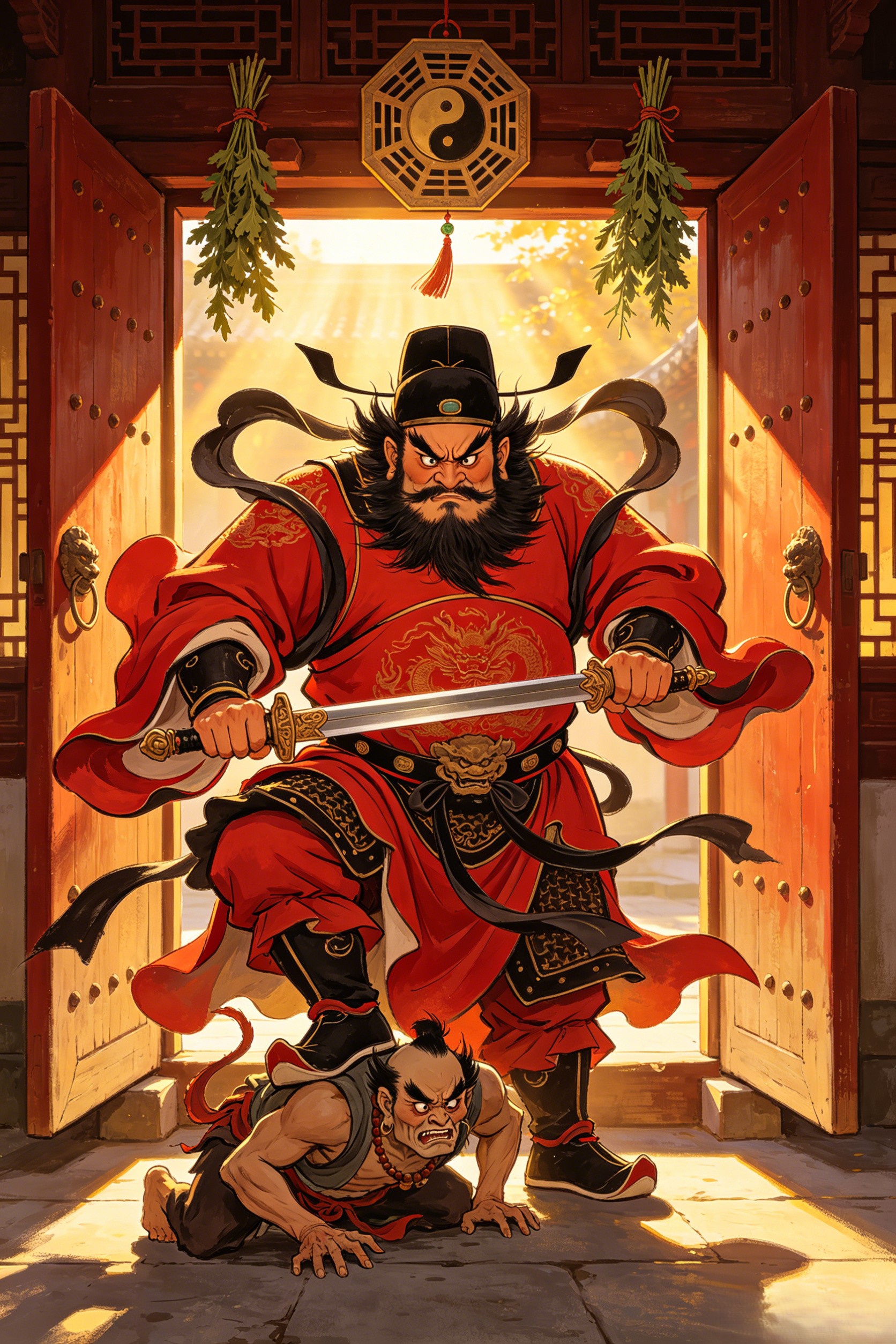
The Zhong Kui door god image follows strict iconographic rules that have been preserved for over a thousand years. Any deviation from these rules is believed to render the image powerless or, worse, to attract negative energy instead of repelling it. Understanding these rules is essential for anyone who wishes to properly display a Zhong Kui image in their home.
The Five Essential Elements
Every proper Zhong Kui door god image must contain five elements. First, the Red Official Robe — the flowing crimson garment of a Tang Dynasty scholar-official. The red must be a deep, cinnabar hue, the color of yang energy and spiritual authority. Second, the Seven-Star Sword, held in the right hand and preferably raised in a striking pose. Third, the fierce expression — bulging eyes, a thick beard, dark skin, and an open mouth showing teeth. Fourth, the black official's cap (wusha mao), with its distinctive "wings" on either side. Fifth, and crucially, at least one demon being subdued — usually a small, black or green demon being stepped upon or held at sword-point.
Wu Daozi's Original Masterpiece
The original Zhong Kui painting by Wu Daozi (吴道子, 680-760 CE) is considered the foundational artwork of the entire door god tradition. Wu Daozi, known as the "Sage of Painting" (画圣), was famous for his dynamic brushwork and his ability to capture the spiritual essence of his subjects. His Zhong Kui painting was said to be so lifelike that viewers felt the figure's eyes following them across the room — a sign, traditionalists said, that the god's spirit truly inhabited the image. The original painting has been lost to history, but countless copies, rubbings, and adaptations have preserved its essential composition through the centuries.
A later emperor of the Song Dynasty, Emperor Renzong, commissioned a set of standardized Zhong Kui images to be distributed to officials throughout the empire. This marked the first government-sponsored mass production of the door god image and established the iconographic norms that continue to this day. The Song Dynasty also saw the emergence of New Year prints (nianhua) of Zhong Kui — woodblock prints that could be mass-produced and sold to ordinary families during the Chinese New Year season.
How to Properly Display a Zhong Kui Image
The placement of the Zhong Kui door god image is as important as the image itself. The image must be posted on the outside of the door, facing outward — never inward. The logic is simple: Zhong Kui must see the approaching spirits before they reach the threshold. If the image faces inward, it would be guarding the interior rather than blocking entry. The image should be placed at approximately eye level, centered on the door panel. In traditional practice, the image is pasted directly onto the wooden door with rice paste, and a new image is applied each year at Chinese New Year, with the old one left in place to show the accumulated layers of protection.
There is also a specific ritual for activating a new Zhong Kui image. The household head must light three incense sticks, bow three times before the image, and recite a short prayer: "Zhong Kui, great demon queller, protect this household from all evil. Let no ghost pass this threshold. Let no demon enter this home. In the name of Heaven, I seal this door." The incense is then placed in a small holder beneath the image, and the smoke is allowed to drift across the print, spiritually charging it. Only after this ritual is the image considered fully activated.
Dragon Boat Festival & Zhong Kui 端午与钟馗
While Zhong Kui images are renewed during Chinese New Year, the Dragon Boat Festival (Duanwu Jie, 端午节) is the holiday most intimately associated with the Demon Queller. The Dragon Boat Festival, celebrated on the fifth day of the fifth lunar month (typically June), has a unique connection to Zhong Kui that sets him apart from all other door gods. This connection stems from the festival's ancient purpose: warding off pestilence, poisonous creatures, and summer diseases.
The fifth lunar month was traditionally considered the most dangerous time of the year in Chinese folk medicine. It was the beginning of summer, when heat and humidity brought outbreaks of disease, poisonous snakes and insects emerged from hibernation, and the boundary between the living and the dead was believed to thin. The "Five Poisonous Creatures" (五毒) — snake, scorpion, centipede, toad, and spider — were said to be at their most active and dangerous. To counter these threats, Chinese households would hang Zhong Kui images alongside bundles of mugwort and calamus (ai cao and chang pu), whose strong aromas were believed to purify the air and repel disease.
The specific Zhong Kui image used during the Dragon Boat Festival is often different from the New Year version. The Dragon Boat Festival Zhong Kui is typically depicted with a sword dipped in the blood of a sacrificed rooster, the rooster being another powerful symbol of yang energy and dawn. In some versions, he carries a magic mirror (zhaoyaojing) in addition to his sword, using the mirror's reflected light to expose and burn hidden demons. The image is sometimes accompanied by a talisman reading "Zhong Kui wards off the five poisons" (钟馗镇五毒).
The tradition of hanging Zhong Kui during the Dragon Boat Festival was particularly strong in southern China, especially in Jiangsu, Zhejiang, and Fujian provinces. In these regions, entire festivals were built around the creation and display of Zhong Kui images. Calligraphers and folk artists would compete to produce the most powerful and beautiful Zhong Kui portraits, and households would vie to display the most impressive images. The tradition continues today in many rural communities, though it has declined in China's rapidly urbanizing cities.
The connection between Zhong Kui and the Dragon Boat Festival is also expressed through Zhong Kui opera performances (钟馗戏). During the festival, traveling opera troupes would perform the story of Zhong Kui's life and battles, often incorporating acrobatic elements and elaborate costumes. The most famous of these performances is "Zhong Kui Marries Off His Sister" (钟馗嫁妹), a comic opera that contrasts the fearsome demon queller with his tender love for his younger sister. These performances were considered more than entertainment — they were ritual acts of protection, with Zhong Kui's presence on stage driving away evil spirits from the entire community.
Zhong Kui vs Other Door Gods 门神比较
To fully appreciate Zhong Kui's unique role as a door god, it is helpful to compare him with the other major door gods in the Chinese tradition. The Chinese door god pantheon is broadly divided into two categories: military door gods (武门神) and civil door gods (文门神). Zhong Kui occupies a unique space that bridges both categories — a scholar's robe covering a warrior's soul.
Military Door Gods: Qin Qiong and Yuchi Gong
Qin Qiong and Yuchi Gong are the most famous of the military door gods. Both were historical generals of the Tang Dynasty, deified for their loyalty and martial prowess. In door god images, they are always depicted in full armor, carrying weapons — Qin Qiong with his paired maces and Yuchi Gong with his iron whip. Their images are typically posted as a pair, one on each door panel, facing each other. Their power comes from their mortal military authority. They guard against physical threats, human invaders, and the ghosts of those who died in battle. They are the most common door gods in northern China.
Civil Door Gods: Scholars and Pattern Mandarins
The civil door gods are depicted as scholars and officials in flowing robes, carrying scrolls, ceremonial tablets, or auspicious symbols. They are associated with literary success, official rank, and good fortune rather than physical protection. Figures like Wenchang Wang (the god of literature) and Kuixing (the god of examinations) are sometimes posted on the doors of scholars and students. These door gods do not fight demons but rather attract good fortune and success.
Where Zhong Kui Stands Apart
Zhong Kui is unique among door gods because he combines elements of both traditions. Like the military door gods, he is a fierce warrior who fights and destroys evil. Unlike them, he wears the red robe of a scholar, not the armor of a general. Like the civil door gods, he is associated with scholarship and learning — his origin story is that of a top scholar wronged by the examination system. But unlike them, his primary function is protection, not fortune-bringing. Zhong Kui is neither purely military nor purely civil. He is a scholar who fights, a ghost who hunts ghosts, a creature of the spirit world who defends the mortal world. This hybrid identity is the source of his enduring appeal.
Another key distinction is that Zhong Kui is almost always posted as a single image, not a pair. While Qin Qiong and Yuchi Gong require two door panels (one general on each side), Zhong Kui's image is complete and self-sufficient. He is both the protector of the left door and the right door, the yang door and the yin door, the outer gate and the inner chamber. He needs no partner because his power encompasses all directions. This makes him particularly popular for single-door entrances, such as apartment doors and back doors.
Zhong Kui is also the only major door god who is actively feared by demons rather than merely respected. The stories of Zhong Kui describe demons fleeing in terror at the mere sight of his shadow, collapsing in fear when they hear his name, and begging for mercy before he even raises his sword. The other door gods are guardians; Zhong Kui is a predator — the thing that evil spirits fear most. This distinction is crucial: the fear that Zhong Kui inspires is not the fear of punishment but the instinctive terror of prey for its predator.
Modern Door God Practices 现代门神习俗
In contemporary China, the tradition of posting door gods has undergone significant changes, but Zhong Kui's presence has remained remarkably resilient. While urbanization, modernization, and the cultural disruption of the Cultural Revolution led to a decline in many traditional practices, Zhong Kui door god images have experienced a revival in recent decades. Today, they can be found in contexts ranging from traditional village homes to cutting-edge digital art installations.
In rural China, the traditional practices remain largely intact. During Chinese New Year, village markets still sell woodblock-printed Zhong Kui images alongside other door gods and auspicious decorations. Farmers paste fresh images on their doors and gates, often accompanied by the traditional activation ritual of incense and prayer. The Dragon Boat Festival Zhong Kui images are also still produced and displayed, though the practice has become less common in younger generations. Many rural households maintain a year-round Zhong Kui image on their main door, replacing it only when it becomes too faded or damaged.
In urban China, the tradition has adapted to modern living conditions. Apartment dwellers who cannot paste paper images on their steel security doors instead display small embroidered Zhong Kui pendants on keychains, car rearview mirrors, or handbags. Digital Zhong Kui images circulate on WeChat and other social media platforms, with users "posting" the demon queller on their virtual profile pictures during festivals. Some tech companies have even created augmented reality Zhong Kui apps that allow users to project a 3D animated Zhong Kui onto their smartphone camera's view of their front door. These modern adaptations show the remarkable flexibility of the door god tradition.
Beyond China, the Zhong Kui door god tradition has traveled with Chinese diaspora communities to every continent. In Chinatowns around the world, specialty shops sell Zhong Kui prints during the New Year season. In Southeast Asian countries with large Chinese populations — Malaysia, Singapore, Indonesia, Thailand — the tradition is particularly strong. Some Thai households have even syncretized Zhong Kui with local spirit beliefs, creating hybrid protective images that blend Chinese and Southeast Asian iconography. In Western countries, Zhong Kui images can be found in Chinese restaurants, martial arts schools, and the homes of Chinese immigrants.
The commercial art market has also embraced Zhong Kui. Contemporary Chinese artists have reinterpreted the door god image in countless styles — from traditional meticulous brushwork (gongbi) to pop art, street art, and digital illustration. Some artists have created female Zhong Kui figures, cyberpunk Zhong Kui, and even cartoon Zhong Kui characters for children's media. While these artistic innovations sometimes depart from traditional iconographic rules, they demonstrate the living, evolving nature of the door god tradition and ensure that Zhong Kui remains relevant to new generations.
Perhaps most importantly, the Zhong Kui door god tradition has found new meaning in the post-pandemic world. As people around the globe have become more conscious of invisible threats and the vulnerability of the threshold between the private home and the dangerous outside world, Zhong Kui's role as a protector against invisible evil has resonated with new audiences. The ancient door god, it seems, has something to teach us about the universal human need to feel safe within our own walls.
To trace the full arc of Zhong Kui's story from his earliest origins as a wronged scholar through his epic ghost-hunting battles and his continuing veneration in temples across China, explore the other sections of our Zhong Kui guide. For a deeper understanding of his cultural legacy in art, opera, and film, see the Legacy page. Those interested in the broader pantheon of Chinese protective deities may also wish to compare Zhong Kui with Guan Yu, the God of War, whose role as a guardian deity parallels and differs from the Demon Queller's mission, or explore Sun Wukong, the Monkey King, whose rebellious journey against Heaven offers a contrasting perspective on divine authority. For the celestial ruler who appointed Zhong Kui as Demon Queller, see the Jade Emperor.