Wu Daozi's Original Portrait
Every depiction of Zhong Kui that exists today — every temple statue, every New Year print, every film poster, every video game character model — traces its lineage back to a single lost masterpiece. In 736 CE, the Tang Dynasty's greatest painter, Wu Daozi (吴道子, 680–760 CE), was summoned to the imperial court by Emperor Xuanzong. The emperor had recently recovered from a debilitating illness after dreaming of a fierce red-robed figure who devoured the demon tormenting him. Grateful and awestruck, Xuanzong described the vision in vivid detail to Wu Daozi, commissioning him to capture it on silk.
What Wu Daozi produced became the fountainhead of Zhong Kui iconography. His portrait showed a towering figure with a thick, bristling beard and a face so ugly it was terrifying — yet so righteous it was holy. Zhong Kui wore the red robe of a Tang scholar-official, a reminder of his mortal rank unjustly denied, and carried a sword that symbolized his divine authority to execute evil spirits. His eyes, painted with Wu Daozi's signature "thunderbolt" brushstroke technique, seemed to follow the viewer, bulging with an intensity that legend claimed could drive away demons on its own. The original painting was kept in the imperial collection and was copied countless times by court painters. Tragically, the original Wu Daozi Zhong Kui was lost during the wars and upheavals that marked the end of the Tang Dynasty. No surviving copy is believed to be by Wu Daozi's own hand. The oldest surviving copies date from the Song Dynasty, several centuries after the original, but they remain our most precious link to the master's vision. These Song copies, housed in museums in Beijing and Taipei, show a Zhong Kui that is both terrifying and deeply human — a deity with the face of a demon and the heart of a wronged scholar.
Zhong Kui in Classical Chinese Literature
Even before Wu Daozi's brush touched silk, Zhong Kui had begun his literary journey. The earliest surviving written reference appears in the Tang Dynasty's comprehensive ritual encyclopedia, where he is listed among the spirits to be invoked during the annual exorcism ceremony (大傩). But it was the Song Dynasty that truly embraced Zhong Kui as a literary subject. Poets like Su Shi (苏轼, 1037–1101) composed verses celebrating the Demon Queller, often using his story as a metaphor for the scholar-official class's frustration with a system that judged by appearance rather than merit — a theme that resonated deeply in a society obsessed with the imperial examination system.
The Song Dynasty also saw the proliferation of zhiguai tales (志怪, "records of the strange") featuring Zhong Kui. These short stories, collected in anthologies like the Taiping Guangji (太平广记), expanded his mythology considerably. In one tale, Zhong Kui leads a ghostly army against the plague spirits of the south. In another, he confronts a particularly cunning fox spirit who has been impersonating a Buddhist monk, and the two engage in a shape-shifting battle reminiscent of the Monkey King's exploits. The Ming Dynasty produced the most significant work of Zhong Kui literature: the "Biography of Zhong Kui" (《钟馗传》), a full-length novel attributed to the playwright Zhang Dai (张岱). This work, which survives in several manuscript copies, narrates Zhong Kui's complete life story — from his miraculous conception to his scholarly career, his tragic death, his deification, and his ongoing ghost-hunting adventures in the spirit world. The novel is remarkable for its blending of satire, horror, and comedy, treating Zhong Kui as simultaneously a figure of terror and a figure of fun — a duality that would define his cultural image ever after.
Zhong Kui on the Opera Stage
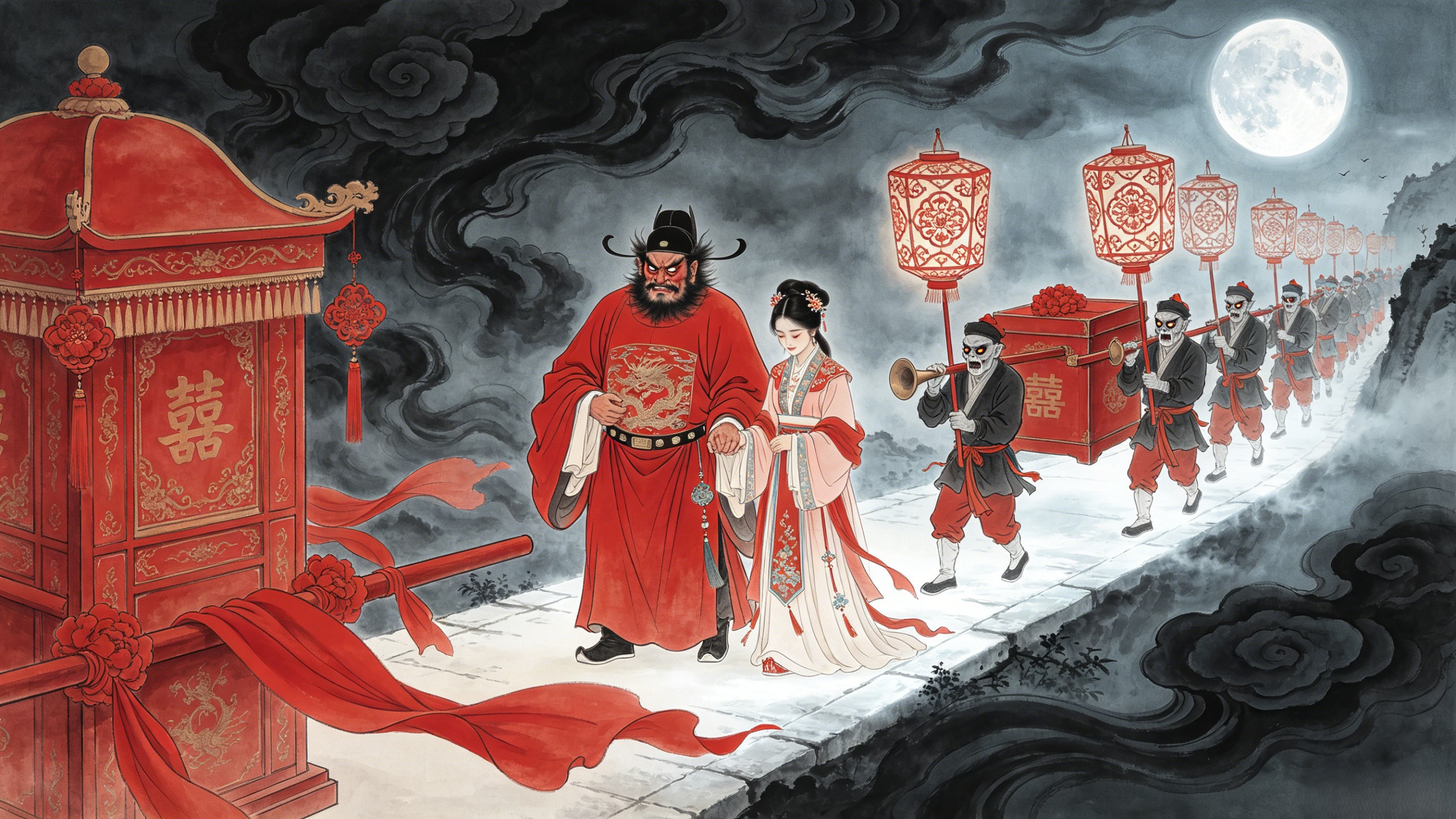
If literature gave Zhong Kui a voice, the Chinese opera stage gave him a body. The operatic tradition of Zhong Kui is one of the most physically demanding and visually spectacular in all of Chinese performing arts. The most famous opera is "Zhong Kui Marries Off His Sister" (《钟馗嫁妹》, Zhong Kui Jia Mei), a classic of Beijing Opera that has been performed continuously since the Qing Dynasty. The plot follows Zhong Kui in the underworld, where he has become a god, as he remembers his beloved younger sister still living in poverty above. Leading a procession of ghosts — each one a distinct character with its own makeup and movement vocabulary — Zhong Kui visits his sister, arranges her marriage to his loyal friend Du Ping, and escorts her wedding procession through the spirit world to the mortal realm.
The makeup (脸谱, lianpu) for the Zhong Kui role is among the most complex in all of Chinese opera. The base color is black, representing his fierce and uncompromising nature. Sweeping red and white patterns cross the face, forming a bat-shaped motif across the forehead — the bat (蝠, fu) being a symbol of good fortune, implying that his terrifying appearance brings blessing. The actor must learn to hold his eyes wide throughout the performance, often using small props wedged under the eyelids to maintain the bulging, furious gaze. The costume is equally elaborate: a red robe embroidered with gold dragons and clouds, a black beard that reaches the waist, and a high official's hat that heightens his imposing stature. The Kunqu opera tradition, with its more refined and lyrical style, has produced a somewhat gentler Zhong Kui, one whose ugliness conceals a tender heart, and whose performances emphasize the pathos of his story alongside the spectacle of his power.
The Opera Technique of Tiao Zhong Kui
The physical demands of performing Zhong Kui are legendary within the opera world. The actor must master a specialized vocabulary of movement: a heavy, stomping gait that suggests both his divine weight and his earthbound origins; sudden explosive lunges and sword slashes that terrify the audience as much as the demons; and precise, acrobatic tumbles that demonstrate his ghostly nature (ghosts in Chinese opera move with a specific rolling and tumbling technique). The most demanding moment comes in the wedding procession scene, where Zhong Kui must dance with a sword in one hand and a fan in the other while maintaining his fierce facial expression — a feat of physical control that takes decades to perfect. Great Zhong Kui actors, such as the legendary Hao Shouchen (郝寿臣, 1886–1961), were celebrated for their ability to make the audience simultaneously terrified and moved to tears.
Zhong Kui in Cinema & Television
The 20th century brought Zhong Kui to a new medium, and the Demon Queller proved remarkably adaptable to the language of film. The first cinematic depiction appeared in Shanghai in the 1930s, a silent short film that used the Zhong Kui exorcism dance as its centerpiece. But the first major motion picture was "The Ghost Story of Zhong Kui" (《钟馗捉鬼》, 1965), a Hong Kong production starring the opera-trained actor Cheng Pei-kei. The film combined traditional Chinese opera aesthetics with the horror and fantasy conventions of Shaw Brothers Studio's golden age, presenting Zhong Kui as a supernatural avenger who hunts down those who have escaped earthly justice.
In 1994, Hong Kong cinema produced what many consider the definitive Zhong Kui film: "The Chinese Ghostbuster" (《钟馗嫁妹》, also known as Zhong Kui Marries Off His Sister), directed by and starring the legendary opera actor Yuen Biao. The film married authentic Beijing Opera techniques with 1990s Hong Kong action choreography, creating a breathtaking hybrid that introduced Zhong Kui to a new generation. Yuen Biao's performance was noteworthy for its physicality; a trained martial artist and acrobat, he performed his own stunts in the full opera costume and makeup, leaping across rooftops, somersaulting through temples, and executing sword fights that would have been impossible for a traditional opera performer.
Television has also embraced the Demon Queller. The 42-episode Chinese TV series "The Legend of Zhong Kui" (《钟馗传说》, 2012) reimagined him as a comic hero investigating supernatural cases, blending procedural drama with Chinese ghost folklore. More recently, the 2023 streaming series "Zhong Kui: Nightmare Hunter" updated the myth for the horror-thriller genre, presenting Zhong Kui as a tormented immortal who hunts demons while wrestling with the memory of his own unjust death. This television evolution reflects Zhong Kui's remarkable generic flexibility: he can be a horror figure, a action hero, a comic protagonist, or a tragic anti-hero, depending on the needs of the story.
Video Games & Digital Zhong Kui
The 21st century has seen Zhong Kui achieve something his Tang Dynasty worshippers could never have imagined: he has become a global video game character. His most prominent game appearance is in Smite, the third-person multiplayer online battle arena (MOBA) game developed by Titan Forge Games. Added to the game in 2016 as part of its Chinese pantheon roster, Zhong Kui is depicted as a rotund, robe-clad mage who wields his brush and scroll as weapons, summoning ghostly minions and healing himself by consuming captured souls. The design draws heavily on traditional iconography — his red robe, his black beard, his bulging eyes — while adapting him for the global gaming audience. His ultimate ability, "Exorcism," releases a wave of talismanic energy that damages enemies and heals allies, a digital translation of the Daoist exorcism rituals still performed today.
In China, Zhong Kui appears in the massive mobile MOBA Honor of Kings (王者荣耀), the world's most-played game, as a playable character in the "Mage" class. The Chinese game designers invested considerable effort in historical accuracy, consulting with folklore experts to ensure his abilities reflected traditional sources. His in-game model includes detailed talisman designs based on actual Daoist talismans, and his animations incorporate movements from the Zhong Kui opera tradition. Beyond these major titles, Zhong Kui has appeared in numerous other games: as a boss character in Dynasty Warriors spin-offs, as a summonable spirit in the Persona series (under his Japanese name Shoki), and as a character in various Chinese mobile games like Mobile Legends: Bang Bang. Each appearance, no matter how fantastical, retains the core of his identity: the scholar who became a ghost hunter, the wronged man who became a god.
Smite (2016)
Mage class · Scroll & Brush · Soul Collection Mechanic
Honor of Kings
Mage class · Talisman-based Abilities · Opera-Inspired Animations
Persona Series
Summonable Persona · As "Shoki" · Curse-element Attacks
Dynasty Warriors
Boss Character · Exorcism-based Moveset
Contemporary Art & the Demon Queller
In the world of fine art, Zhong Kui continues to inspire Chinese painters working in both traditional and contemporary idioms. The modern ink-wash master Fan Zeng (范曾, born 1938) has produced multiple interpretations of Zhong Kui, each one exploring a different facet of his character — the righteous judge, the loyal brother, the terrifying exorcist. Fan's Zhong Kui paintings are notable for their psychological depth; rather than merely depicting the deity's fearsome exterior, they attempt to capture the inner conflict of a man whose ugliness cost him everything but whose righteousness earned him everything back, transformed and magnified. His 2004 painting "Zhong Kui the Exorcist" (钟馗驱鬼图) sold at auction for over 10 million RMB, a testament to the enduring market appeal of the Demon Queller.
The contemporary art movement has embraced Zhong Kui with equal enthusiasm. The Beijing-based artist Liu Xiaodong (刘小东) created a provocative 2012 series called "Zhong Kui in the City," which transplanted the Demon Queller into modern urban settings — riding the Beijing subway, shopping in a convenience store, standing before a construction site. The series uses Zhong Kui as a symbol of moral integrity in a rapidly changing society, asking whether the old gods still have a place in China's hyper-modern cities. In the world of pop art and street art, Zhong Kui has become a favorite subject among Chinese graffiti artists, who spray his image on walls from Beijing's 798 Art District to the alleyways of Shanghai, often juxtaposing his traditional red robe with contemporary elements like sneakers, sunglasses, or smartphones. A particularly famous mural in Guangzhou shows Zhong Kui riding a demon the way a bull-rider rides a bucking bull, a Pop Art fusion of Chinese folklore and American rodeo iconography.
Zhong Kui as a Global Cultural Icon
Perhaps the most remarkable chapter in Zhong Kui's long cultural journey is his emergence onto the global stage. As Chinese mythology has gained worldwide recognition in the 21st century, Zhong Kui has traveled further from his mountain home than any Tang Dynasty devotee could have imagined. Western audiences first encountered him through translations of Pu Songling's Strange Tales from a Chinese Studio (聊斋志异), where several stories feature the Demon Queller. Academic studies by scholars like Wolfram Eberhard and Anne Birrell introduced Zhong Kui to Western students of Chinese mythology through their influential reference works.
Today, Zhong Kui appears in Western popular culture with increasing frequency. He features in the Netflix animated series "The Guardians of the Underworld" as a supporting character. Several English-language young adult novels have reimagined his story as urban fantasy, transplanting the Demon Queller to modern cities like San Francisco and London. International comic artists have produced graphic novel adaptations of his legend, and his image — instantly recognizable even to those who do not know his name — appears on T-shirts, posters, and phone cases sold in Chinatowns from New York to Sydney. The global Zhong Kui is less a specifically Chinese deity and more a universal archetype: the ugly hero, the wronged righteous man, the guardian who protects the innocent — themes that transcend cultural boundaries. As Chinese mythology continues to capture the global imagination through films, games, and literature, Zhong Kui stands alongside Sun Wukong, Nezha, and Guan Yu as one of Chinese culture's most enduring and exportable icons. The wronged scholar of Mount Zhongnan has become a citizen of the world.