The battle chronicles
The Palace Nightmare — Devouring the Dream Demon
This was where Zhong Kui proved his divine power. Not on a battlefield, not in the underworld, but inside the dream of a sleeping emperor. Emperor Xuanzong of Tang lay ill in his palace, tormented night after night by a malevolent spirit — a hungry e gui (饿鬼) that crept through his window with skeletal fingers and hollow eyes. Daoist priests chanted. Buddhist monks prayed. Talismans covered every door. Nothing could stop the demon.
Then, in the depths of the emperor's fever dream, a figure appeared in a flash of crimson light. Zhong Kui — the wronged scholar, now a spirit of righteous fury — seized the demon with his bare hands. Some versions say he tore out its eyes. Others say he ripped off its limbs. In every version, he devoured the demon whole, swallowing its essence and erasing it from existence. The emperor awoke cured, and Zhong Kui's divine career had begun.
This battle is extraordinary because it was fought entirely in the dream realm — a space where traditional weapons and armies are useless. Zhong Kui's power here was not military but spiritual authority. He commanded the dream because heaven had given him command over the spirit world. The message was clear: no realm, not even the subconscious of a mortal, was beyond his reach.
This first battle established the template for all of Zhong Kui's subsequent victories: direct, violent, personal. He does not fight from a distance. He does not delegate. He confronts evil face to face and destroys it with his own hands. For the full story of how this battle fit into Zhong Kui's tragic origin, read The Origins of Zhong Kui.
The Five Ghosts Revolt (五鬼闹判)
The most famous battle tale in the Zhong Kui canon. After centuries of dutiful ghost-hunting, Zhong Kui's authority over the spirit world was absolute — or so he believed. But in the dark corners of the underworld, five powerful ghost kings grew resentful of his dominion. These were no ordinary specters. Each had been a notorious figure in life: a corrupt official, a bandit chieftain, a sorcerer, a warmongering general, and a vengeful bride who had murdered her own family. In death, their power had magnified a hundredfold, and they united under a single banner of rebellion.
The ambush came on Zhong Kui's midnight patrol route through the borderlands between the mortal world and the underworld. The five ghosts erupted from the darkness with a coordinated attack. The sorcerer ghost hurled curses that twisted reality itself. The general ghost commanded a legion of skeletal soldiers. The bride ghost wailed with such force that her screams shattered talismans mid-air. The bandit ghost fought with weapons forged from the resentment of a thousand victims. And the corrupt official ghost — the mastermind — used bureaucratic illusions to trap Zhong Kui in an endless maze of false documents and sealed decrees.
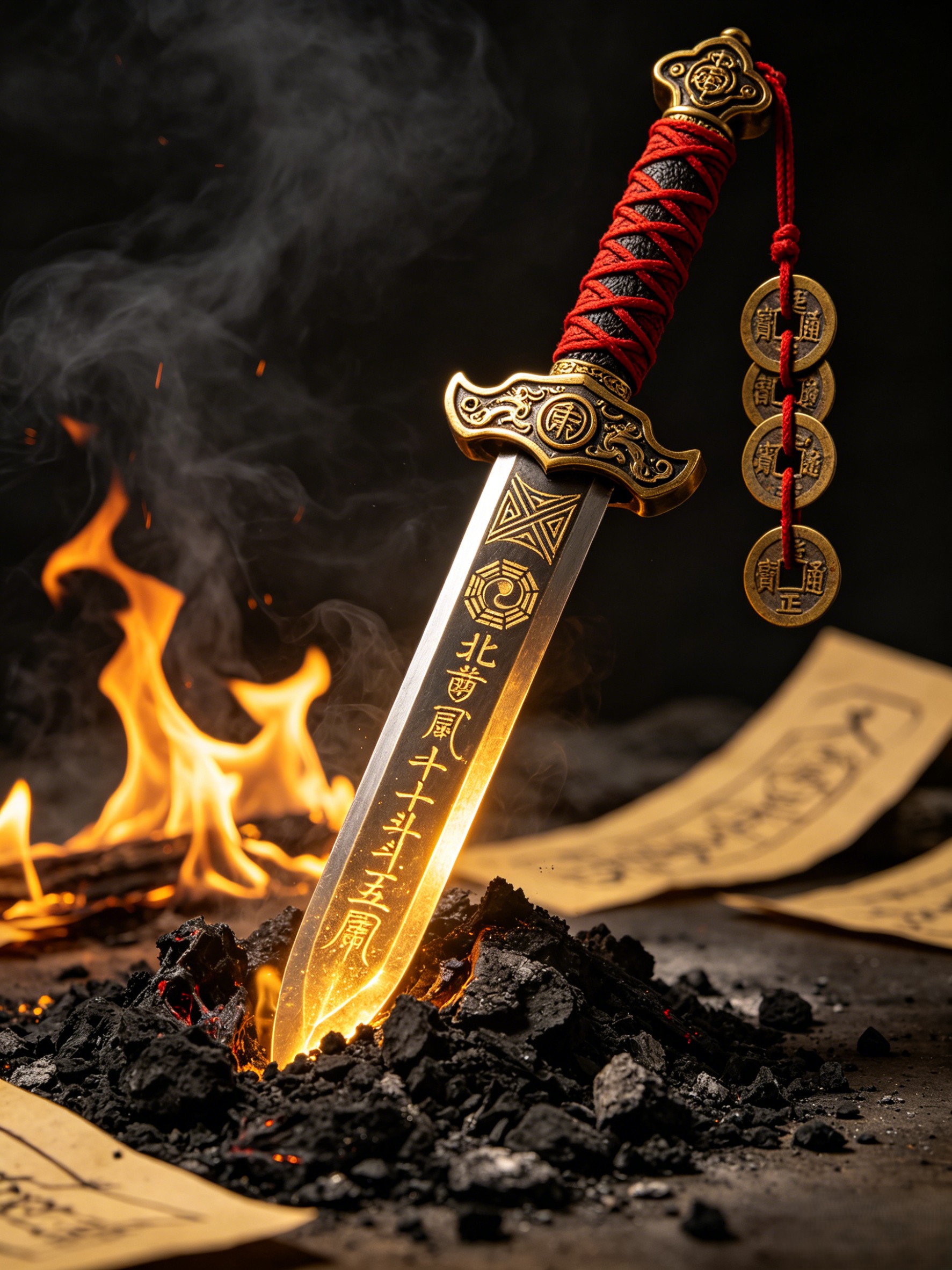
For the first time in his immortal career, Zhong Kui was on the defensive. His cinnabar brush flew, painting protective talismans in the air faster than the sorcerer could dispel them. His Seven-Star Ghost-Slaying Sword swept through the ranks of skeletal soldiers, reducing them to dust with every stroke. But the ghosts were many, and they were coordinated. They had studied his fighting style. They knew his habits. They had prepared for this rebellion for decades.
The turning point came when Zhong Kui realized he could not defeat them with brute force alone. Calling upon the 80,000 ghost soldiers under his command — the army granted to him by the Jade Emperor himself — he surrounded the five rebels and cut off their escape routes. Then, one by one, he bound them with cinnabar talismans — the sacred red seals that are the most powerful weapons in his arsenal. The Five Ghosts, once so proud and defiant, were subdued and bound to Zhong Kui's service.
In most versions of the tale, Zhong Kui did not destroy the five ghosts. Instead, he reformed them, turning their power from rebellion to protection. They became his personal ghost-guards, the vanguard of his demon-hunting army. The tale of the Five Ghosts Revolt thus becomes not just a battle story but a parable of redemption: even the most corrupt spirits can be transformed by a power greater than their own.
This theme of redeeming the fallen connects Zhong Kui to other figures in the Chinese pantheon. The Guanyin story similarly involves the transformation of wild and dangerous forces into benevolent ones, though through compassion rather than combat. And the Nezha legend also features a rebel who becomes a protector — though Nezha's path from destruction to discipline was far bloodier than Zhong Kui's.
The Ghost Wedding — Zhong Kui Marries Off His Sister (钟馗嫁妹)
Not every battle is fought with a sword. The tale of Zhong Kui Marries Off His Sister is the most beloved folk story about the demon queller, and it reveals a different kind of power: the power of command. After becoming a god, Zhong Kui remembered his younger sister, whom he had left behind when he died. She was living in poverty, with no one to protect her and no prospect of a good marriage. Zhong Kui resolved to honor the promise he had made before his death — to see his sister wed to his loyal friend Du Ping (杜平), the only man who had dared to bury Zhong Kui's body with dignity after his suicide at the palace steps.
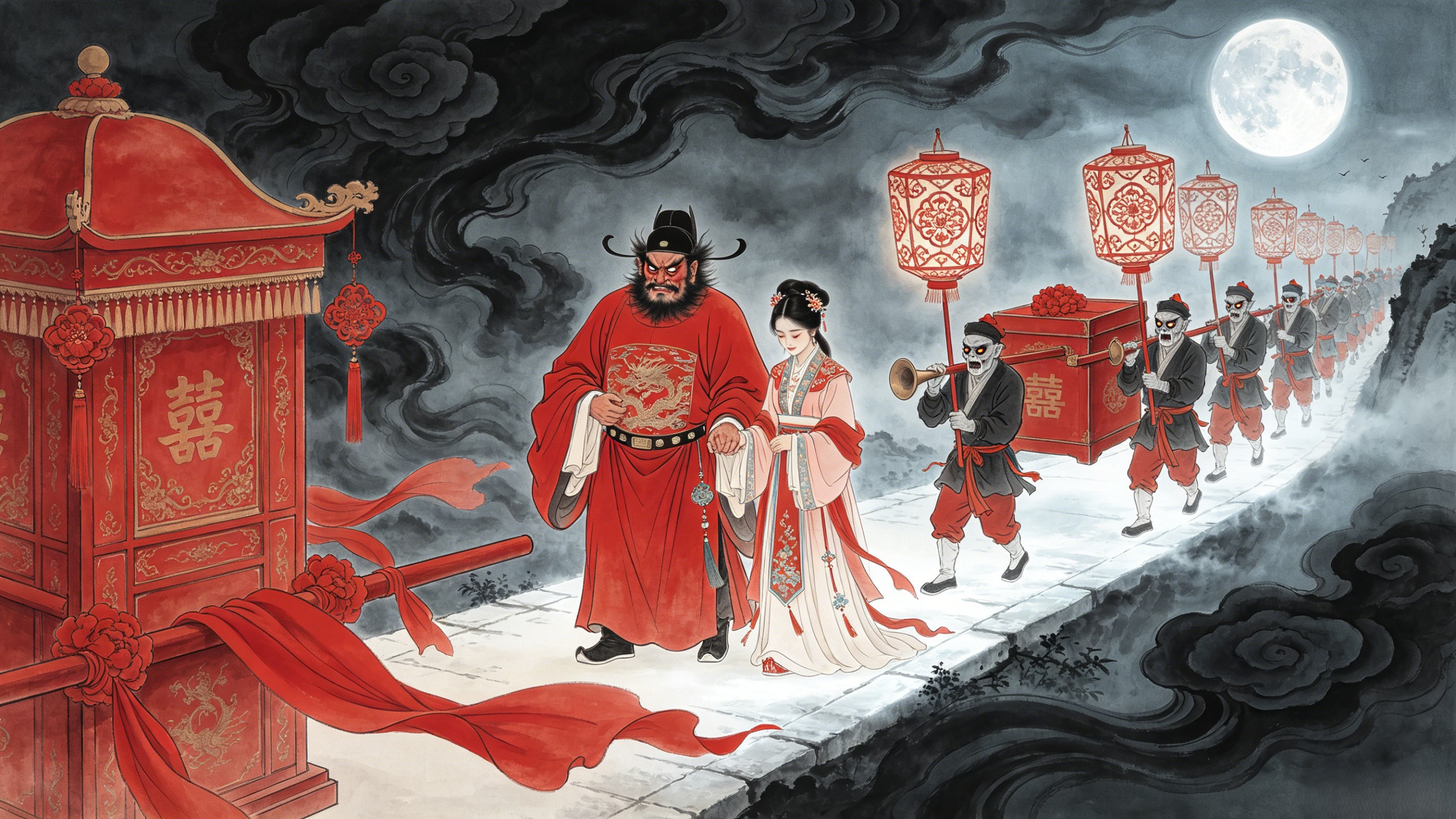
What followed was one of the most visually spectacular events in Chinese folklore. Zhong Kui assembled a wedding procession composed entirely of demons and ghosts — the very spirits he had spent centuries vanquishing. His wedding train was a parade of the supernatural: skeletal musicians playing ghostly flutes and drums, lantern-carrying spirits lighting the way with blue corpse-fires, demon porters bearing chests of phantom gold and silk, and the five reformed ghost kings from the Five Ghosts Revolt serving as honor guards. At the head of the procession rode Zhong Kui himself, resplendent in his crimson scholar's robe, his fierce face arranged in an expression of brotherly tenderness that shocked even the demons who served him.
This story demonstrates Zhong Kui's power in a way that no battlefield victory can. The ghosts who served in his wedding procession were not slaves or prisoners. They were willing subjects who had come to respect — even love — the demon queller who had conquered them. He had transformed fear into loyalty, enmity into devotion. A god who can make demons dance at a wedding is a god whose authority is absolute.
The wedding procession scene has been performed in Chinese opera for centuries, and it remains one of the most popular and emotionally resonant stories in the Zhong Kui canon. The fierce ghost hunter, gentle with his sister, dignified in his gratitude toward Du Ping, and commanding in his authority over the spirit world — this is Zhong Kui at his most human and his most divine simultaneously. For more on how Zhong Kui's story has been adapted for the stage and screen, see Zhong Kui's Cultural Legacy.
This tale of supernatural order echoes the organization of the Chinese spirit world more broadly. The relationship between Zhong Kui and his ghostly retinue parallels the bureaucratic hierarchy of the celestial realm itself. For a deeper understanding of how Chinese mythology structures the relationship between gods, spirits, and mortals, explore the Chinese Mythology guide.
The Village Exorcisms — Protector of the Common People
Beyond the grand tales of ghost kings and imperial dreams lies the true heart of Zhong Kui's legend: the countless unnamed battles he has fought on behalf of ordinary people. In Chinese folk tradition, Zhong Kui is not a distant celestial deity but an active, present protector who can be called upon by anyone, anywhere, at any time.
The pattern of a Zhong Kui village exorcism follows a recognizable structure across hundreds of regional tales. A village falls under a curse: crops wither, children fall ill, strange sounds echo through the night, and villagers report seeing shadowy figures at the edges of their vision. A Daoist priest is consulted, and he determines that an evil spirit has taken up residence. Talismans fail. Prayers go unanswered. The village is desperate.
Then, on the darkest night of the crisis, Zhong Kui appears. He arrives not on a cloud but on foot, a massive figure in red striding out of the darkness. He carries his Seven-Star Sword in one hand and his cinnabar brush in the other. Without ceremony, he walks to the center of the village, draws a protective circle of cinnabar on the ground, and summons the demon to face him.
The confrontations that follow are remarkably consistent in their structure but infinitely varied in their details. The demon might appear as a fox spirit, a drowned ghost, a tree goblin, or a disease-carrying wraith. It might beg, bargain, threaten, or attack. Zhong Kui's response is always the same: he offers the demon a choice — leave the mortal realm forever, or be destroyed utterly. Most demons, recognizing the source of his authority, flee. Those that do not are dispatched with startling efficiency, their essences sealed in gourds or bound into talismans for disposal in the underworld.
These village exorcism tales emphasize Zhong Kui's role as a democratic deity. Unlike gods who require elaborate temples and priestly intercession, Zhong Kui answers the call of any sincere petitioner. His image pasted on a humble farmhouse door carries the same protective power as the grandest temple mural. This accessibility has made him one of the most beloved figures in Chinese folk religion.
The techniques Zhong Kui uses in these exorcisms — talisman circles, cinnabar seals, ghost-binding spells — are rooted in the Daoist ritual tradition. The connection between Zhong Kui and Daoist magic is deep and significant. To understand the philosophical and magical traditions that underpin his power, explore the story of Taishang Laojun, the supreme Daoist deity whose teachings inform much of Chinese ritual magic. For a broader understanding of the creatures Zhong Kui hunts, explore our guide to Chinese mythological creatures and demons.
The Modern Battles — Zhong Kui in Pop Culture
Zhong Kui's war against evil did not end with the age of myth. In modern times, the demon queller has crossed over from temple walls into cinema screens, television series, and video game consoles — and his battles have only grown more spectacular.
The most famous cinematic adaptation remains the 1999 Hong Kong film Zhong Kui (钟馗), which reimagined the demon queller as a tragic action hero, blending martial arts choreography with supernatural horror. The film's fight sequences drew heavily on traditional Chinese opera movements, creating a visual language that felt both ancient and contemporary. The climactic battle against a transformed demon lord remains one of the most celebrated supernatural fight scenes in Hong Kong cinema.
More recently, the 2015 Chinese fantasy film Zhong Kui: Snow Girl and the Dark Crystal (钟馗伏魔:雪妖魔灵) brought the demon queller to a global audience. Starring Chen Kun as Zhong Kui, the film used modern CGI to depict the spirit world in spectacular detail, pitting Zhong Kui against demons ranging from ice spirits to underworld warlords. While the film took creative liberties with the traditional lore, it succeeded in introducing Zhong Kui to a new generation and sparked renewed interest in the original legends.
In the world of video games, Zhong Kui appears as a playable character in several Chinese-developed action games, including the popular mobile title Racing Horse (驭马) and various MOBA-style arena games. In these digital incarnations, his iconic sword-and-talisman fighting style translates naturally to interactive combat, and his distinctive visual design — the red robe, the iron beard, the bulging eyes — makes him instantly recognizable even to players unfamiliar with his mythological origins.
Zhong Kui has also found a home in contemporary literature, where authors have reimagined his battles in genres ranging from urban fantasy to steampunk. In these modern retellings, the demon queller patrols not ancient villages but modern cities, hunting ghosts in neon-lit alleyways and subway tunnels. The core narrative remains the same: a wronged scholar turned divine protector, fighting an eternal war against the forces of darkness.
This modern evolution of Zhong Kui parallels the journeys of other Chinese mythological figures in contemporary media. Sun Wukong has perhaps the most extensive presence in global pop culture, appearing in everything from Dragon Ball to Loki. And Erlang Shen has been featured in numerous video games and films as the archetypal celestial warrior. Zhong Kui, however, remains unique: he is the only major Chinese deity whose entire identity is defined by battle against the supernatural, making him the perfect bridge between ancient myth and modern horror-action storytelling.