Chang'e's Celestial Home

The Guanghan Palace: Life on the Moon with Chang'e

A palace of ice and jade suspended above the earth. A rabbit that grinds medicine for eternity. A man condemned to chop a tree that never falls. This is what waits on the moon.

When you look up at the full moon on a clear autumn night, you are not looking at a lifeless sphere of rock and shadow. In Chinese mythology, that argent disc is a living world — a realm of ice palaces, immortal rabbits, and trees that heal as fast as they are cut. At its heart lives Chang'e, the Moon Goddess, who has watched over humanity from her celestial home for over four millennia. Her dwelling is the Guanghan Palace (广寒宫), the Palace of Expansive Cold — a place of such profound beauty and such crushing loneliness that it has haunted the Chinese imagination for thousands of years.

The palace is the most remote location in all of Chinese mythology. It cannot be reached by any mortal road. It cannot be found by any earthly map. It floats on the surface of the moon, suspended in the void between Heaven and Earth, accessible only to those who have consumed the Elixir of Immortality or tread the paths of the celestial realm. And within its frozen halls dwell three souls bound together by fate: a goddess who chose the moon over tyranny, a rabbit who offered her own life for a stranger, and a man who has been swinging an axe for longer than human civilization has existed.

What Is the Guanghan Palace?

The Guanghan Palace is not a palace in any earthly sense. There are no bustling throne halls, no armies of guards, no courtly entertainments echoing through marble corridors. It is a structure of pure ice, luminous jade, and crystalline moonlight that drifts silently across the lunar surface. Its walls shimmer with a pale silver radiance that seems to come from within the stone itself. Its halls stretch endlessly under ceilings of frozen starlight, and its courtyards are filled with the ghostly blossoms of the osmanthus tree — the only living thing that grows there. The air is perpetually cold, but it is not the biting cold of a winter storm; it is the deep, still cold of a place that exists beyond the reach of the sun's warmth.

The name itself tells the story. "Guanghan" (广寒) means "expansive cold" — not the cold of a season that passes, but the cold of eternity. The palace is beautiful beyond measure, but it is also a kind of prison. Chang'e did not choose to live there; she was carried there by the Elixir of Immortality, a potion so powerful that it lifted her from the mortal world whether she was ready to leave or not. She did not ascend in triumph like the gods of Olympus. She ascended in a moment of desperate choice — drinking the elixir to prevent it from falling into evil hands, and watching the earth shrink beneath her as the moon drew her inexorably upward.

To understand the Guanghan Palace is to understand a core tension in Chinese mythology: the pursuit of immortality is not always a blessing. Sometimes it is a sentence. Sometimes the price of living forever is living alone. The palace is the physical manifestation of that paradox — a dwelling of peerless beauty built for a woman who would give anything to walk the earth just once more.
The Jade Rabbit

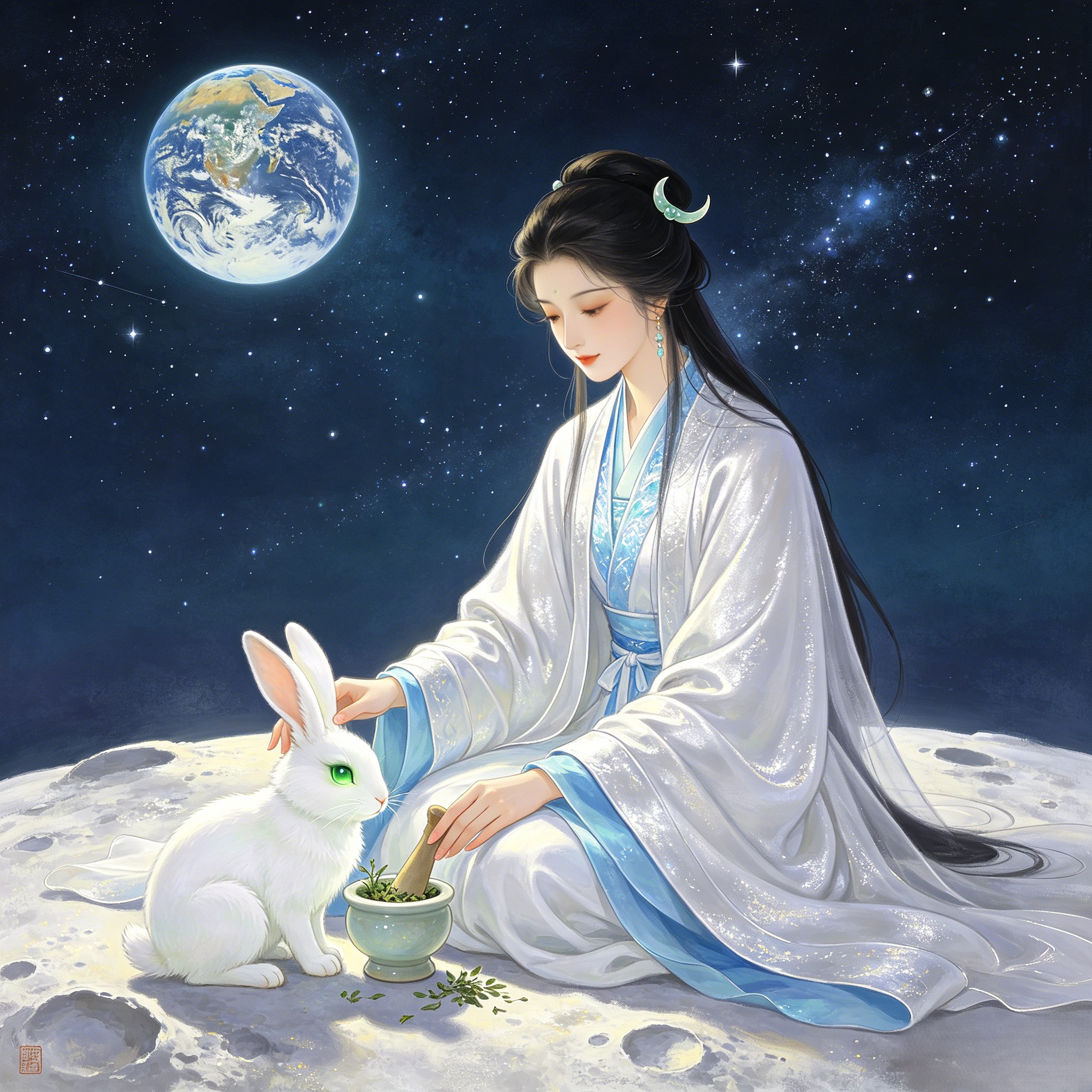
If the Guanghan Palace is a prison of solitude, then the Jade Rabbit is Chang'e's one true comfort — the only companion who shares the moon's infinite silence. Night after night, century after century, a small white rabbit sits beneath the osmanthus tree, grinding celestial herbs in a mortar made of pure jade. The rhythmic tap-tap-tap of her pestle is the only sound that breaks the moon's eternal stillness.

But how did a rabbit come to live on the moon? The story begins not with Chang'e, but with a test. Long ago, the Jade Emperor, ruler of Heaven, decided to test the virtue of three animals: a fox, a monkey, and a rabbit. He disguised himself as a starving old man and approached each of them, begging for food. The fox, clever and resourceful, offered him a fish she had stolen from a nearby village. The monkey, generous and quick, offered him fruit he had gathered from the treetops. But the rabbit had nothing to give. She had no skill at hunting, no talent for gathering. She could not swim to catch fish, nor could she climb high enough to reach the ripest fruit. She looked at the old man's hollow cheeks and desperate eyes, and she made a choice that would echo through eternity.

She told him to build a fire. When the flames were high and crackling with heat, she bowed once — and threw herself into the fire, offering her own flesh as food so that the old man might not starve.

Chang'e and the Jade Rabbit — intimate portrait of the Moon Goddess with her companion on the lunar surface

The Jade Emperor was so moved by the rabbit's selfless sacrifice that he did not let her die. He reached into the flames and gathered her up, restoring her to life with a single touch. Then he placed her on the moon in the Guanghan Palace, where she would be honored forever. The rabbit was given a mortar and pestle of pure jade, and she spends eternity grinding the herbs of immortality — pounding celestial ingredients into a medicine that could grant eternal life to anyone worthy of it. She is still grinding today. If you look at the full moon on a clear night, you can see her shadow, eternally working, eternally giving.

Wu Gang and the Eternal Osmanthus Tree

The Jade Rabbit is not the only soul condemned to eternal labor on the moon. There is another figure, quieter and more solitary, who has been swinging an axe in the courtyard of the Guanghan Palace for longer than recorded history. His name is Wu Gang.

Wu Gang was a man of immense ambition who desperately sought immortality. He studied the celestial arts with genuine dedication, but his impatience consumed him. He cut corners where he should have been patient. He demanded shortcuts where there were none. And when he was finally brought before the celestial court for his transgressions — for offending the gods with his arrogance and his refusal to follow the proper path to enlightenment — his punishment was not death. It was something far more terrible, and far more creative.

He was sent to the moon and ordered to chop down the great osmanthus tree that grows in the courtyard of the Guanghan Palace. The tree stood eight hundred feet tall, its trunk as wide as a house, its branches heavy with fragrant golden blossoms that never withered or fell. Wu Gang seized his axe and swung with all his might. The blade bit deep into the wood. Splinters flew. And then, as he lifted the axe for his next swing, the wound in the tree healed completely — the bark sealing itself as if he had never struck it at all.

Day after day, year after year, century after century, Wu Gang swings his axe at the osmanthus tree. The tree never falls. His labor never ends. But there is a strange mercy hidden in this punishment: Wu Gang cannot die, and so he cannot truly fail. The tree cannot be defeated, but neither can he. The two of them — the man and the tree — are locked in an eternal dance that will outlast the stars. He has become a cautionary figure in Chinese mythology, a reminder that the universe does not bend to ambition alone. Some lessons can never be unlearned. Some labors never end.

A Day on the Moon

What is it like to live in the Guanghan Palace? The myths describe it only in fragments, but across thousands of years of Chinese poetry and storytelling, a picture emerges of a life that is at once beautiful beyond imagining and heartbreaking beyond words.

Chang'e wakes to no sunrise. The moon has no atmosphere, no weather, no change of seasons. The same silver light always filters through the jade lattice windows of the palace. The same stars shine with a fixed, unwinking brightness that never varies from night to night. And below her, suspended in the velvet blackness of space, hangs the Earth — the blue planet where she was born, where she loved and was loved, where she walked on grass and felt the rain on her skin. She can see it clearly, the continents rotating beneath their blanket of clouds, the great oceans glittering in the sunlight. She can see it, but she can never touch it again.

Her days are filled with small, quiet rituals. She tends the osmanthus blossoms that drift through the frozen courtyards, their fragrance the only sweetness in the cold, sterile air. She watches the Jade Rabbit grinding her endless medicine, the rhythm of mortar and pestle a constant companion — tick, tock, tick, tock — like a clock measuring time that has no meaning anymore. Sometimes she walks to the edge of the palace and simply looks down at the Earth, watching the shadow of night creep across the continents, watching the lights of human cities blink on one by one, knowing that somewhere down there, people are looking up at her moon and telling her story to their children.

But the silence is the hardest part. On the moon, there is no wind, no rain, no birdsong, no distant rumble of thunder. Just the vast, indifferent silence of the cosmos — a silence so deep and so complete that it becomes a presence of its own. And yet, in that silence, Chang'e has found something precious: a perspective that no mortal can ever possess. She sees the Earth as a whole — not as a collection of nations and borders and quarreling tribes, but as a single, fragile world, suspended in the void, shimmering with life. She watches humanity from afar, and she loves them still. She loves them the way one loves a home one can never return to.

Once a year, on the fifteenth night of the eighth lunar month, the moon is at its fullest and brightest. On that night — the Mid-Autumn Festival — the people of Earth look up at her and remember. They gather with their families. They light lanterns. They share mooncakes and tell her story. For one night, the silence is broken by the laughter of a billion voices rising like incense smoke toward the sky. And Chang'e, watching from her palace of ice, is not alone anymore.

Visitors to the Moon Palace

Though the Guanghan Palace is the most remote dwelling in all of Chinese mythology, it is not entirely isolated. Over the millennia, a handful of figures have made their way to the moon — some by accident, some by design, and at least one in disgrace.

The most famous unwelcome visitor is Zhu Bajie. Before he was banished to the mortal realm and born as a half-man, half-pig, Zhu Bajie was the Marshal Tianpeng, a high-ranking celestial officer who commanded the heavenly navy. He was powerful, respected, and utterly undone by his own appetites. One night, intoxicated by celestial wine, he stumbled into the Guanghan Palace and attempted to force himself upon Chang'e. The Moon Goddess rebuffed him with quiet dignity, but the damage was done. The Jade Emperor, upon hearing of the disgrace, stripped Marshal Tianpeng of his rank and banished him from Heaven entirely. He was cast down to earth and accidentally reborn through the womb of a sow — condemned to live out his days as the pig-spirit Zhu Bajie, a punishment that echoes through the entirety of the Journey to the West.

Sun Wukong, the Monkey King, has also visited the vicinity of the moon on several occasions, though his visits were always business rather than pleasure. During his great rebellion against Heaven, the Monkey King's cloud-somersaults carried him across the entire cosmos, and he is said to have glimpsed the silver spires of the Guanghan Palace as he hurtled through the stars. But the cold palace and its silent goddess held little interest for a monkey who had declared himself the Great Sage Equal to Heaven. Later, during the Journey to the West, his mission to protect the monk Tripitaka brought him into contact with lunar magic, moon-based demons, and the mysterious power that radiated from the palace above. For Wukong, the moon was always a place of unanswered questions — a reminder that even he, who had fought Heaven itself to a standstill, had not explored every corner of the cosmos.

And then there is Wu Gang, always there, always swinging his axe in the courtyard. He is not a visitor; he is a permanent resident, sentenced for eternity. His presence means that Chang'e is never truly alone. She shares the moon with two companions: one grinding medicine, one chopping wood, and the silence of the void wrapped around all three of them like a shroud.

The Moon in Chinese Mythology

The Guanghan Palace is a physical place in mythology, but it is also a symbol of something far deeper. In Chinese cosmology, the moon embodies yin energy — the receptive, the cool, the mysterious, the feminine. It stands in eternal balance with the sun, which embodies yang energy — the active, the hot, the bright, the masculine. Chang'e, as the Moon Goddess, is the ultimate expression of yin: calm, wise, introspective, eternal. She does not strive. She does not compete. She simply exists, watching, waiting, enduring.

Taoist philosophy has always looked to the moon as a symbol of the uncarved block — the state of pure potential, untouched by the frantic activity of the mortal world. The moon does not chase after anything. The moon does not grasp or cling. The moon simply shines, reflecting the light of the sun without needing to be the source of it. And in that perfect stillness, Taoist sages found a model for how to live: in harmony with nature, accepting of solitude, at peace with the things that cannot be changed. The Guanghan Palace is not just Chang'e's home; it is the architectural embodiment of that philosophy — a structure that exists not to dominate the landscape but to rest within it, quietly, eternally, at peace with its own isolation.

In modern times, the legacy of the Guanghan Palace has taken on new dimensions. China's lunar exploration program, named after Chang'e herself, has sent multiple missions to the actual moon — robotic spacecraft that have landed on the surface and sent back images of the desolate, beautiful landscape. The modern legacy of the moon goddess is one of exploration and scientific wonder, a bridge between the ancient myths and the space age. The story of the Guanghan Palace reminds us that the same moon that inspires poets and lovers also beckons explorers. The palace of ice and jade still stands, but humanity is slowly, one small step at a time, drawing closer to it.

To understand Chinese mythology is to understand the moon — not as a distant rock, but as a living presence in the cultural imagination. The Guanghan Palace is the heart of that presence: a place where loneliness becomes transcendence, where punishment becomes eternity, and where a single woman's choice echoes through time forever.

Frequently Asked Questions

Does anyone else live on the moon with Chang'e?

Yes. The Jade Rabbit, who grinds the Elixir of Life with a mortar and pestle, has lived on the moon since the Jade Emperor placed her there as a reward for her selfless sacrifice. Wu Gang, a man sentenced by the celestial court, also resides on the moon — condemned to eternally chop a self-healing osmanthus tree that grows outside the Guanghan Palace. While the rabbit is Chang'e's faithful companion and closest friend, Wu Gang remains a solitary figure consumed by his endless task, offering the Moon Goddess occasional company but little warmth. Together, these three souls form the entire population of the lunar realm.

Why was Wu Gang punished to chop the tree forever?

Wu Gang was an ambitious mortal who desperately sought immortality but was undone by his arrogance and impatience. He offended the celestial gods by demanding shortcuts to enlightenment and refusing to follow the proper spiritual path. Rather than executing him, the gods devised a punishment that perfectly matched his crime: he was sent to the moon and ordered to chop down a massive osmanthus tree that magically heals itself each time it is struck. The tree's endless regeneration ensures his labor will never be complete — a fitting sentence for a man who wanted everything too quickly. His story is a cautionary tale in Chinese mythology about the virtue of patience and the danger of hubris.

Can humans visit the Guanghan Palace?

In traditional Chinese mythology, the Guanghan Palace is not accessible to ordinary mortals. It exists in the celestial realm on the moon, separated from the mortal world by an impassable gulf that only divine beings or those who have consumed the Elixir of Immortality can cross. However, the spirit of the palace can be felt during the Mid-Autumn Festival, when the moon is at its fullest and the boundary between worlds is said to grow thin. In the modern era, China's Chang'e lunar exploration program has sent spacecraft to the actual moon, named in honor of the goddess. While no human has yet set foot on the moon as part of this program, the modern legacy of Chang'e has brought the spirit of the Guanghan Palace closer to humanity than ever before — turning an ancient myth into a scientific inspiration.

Dive Deeper