Journey & Folk
Journey & Folk Image
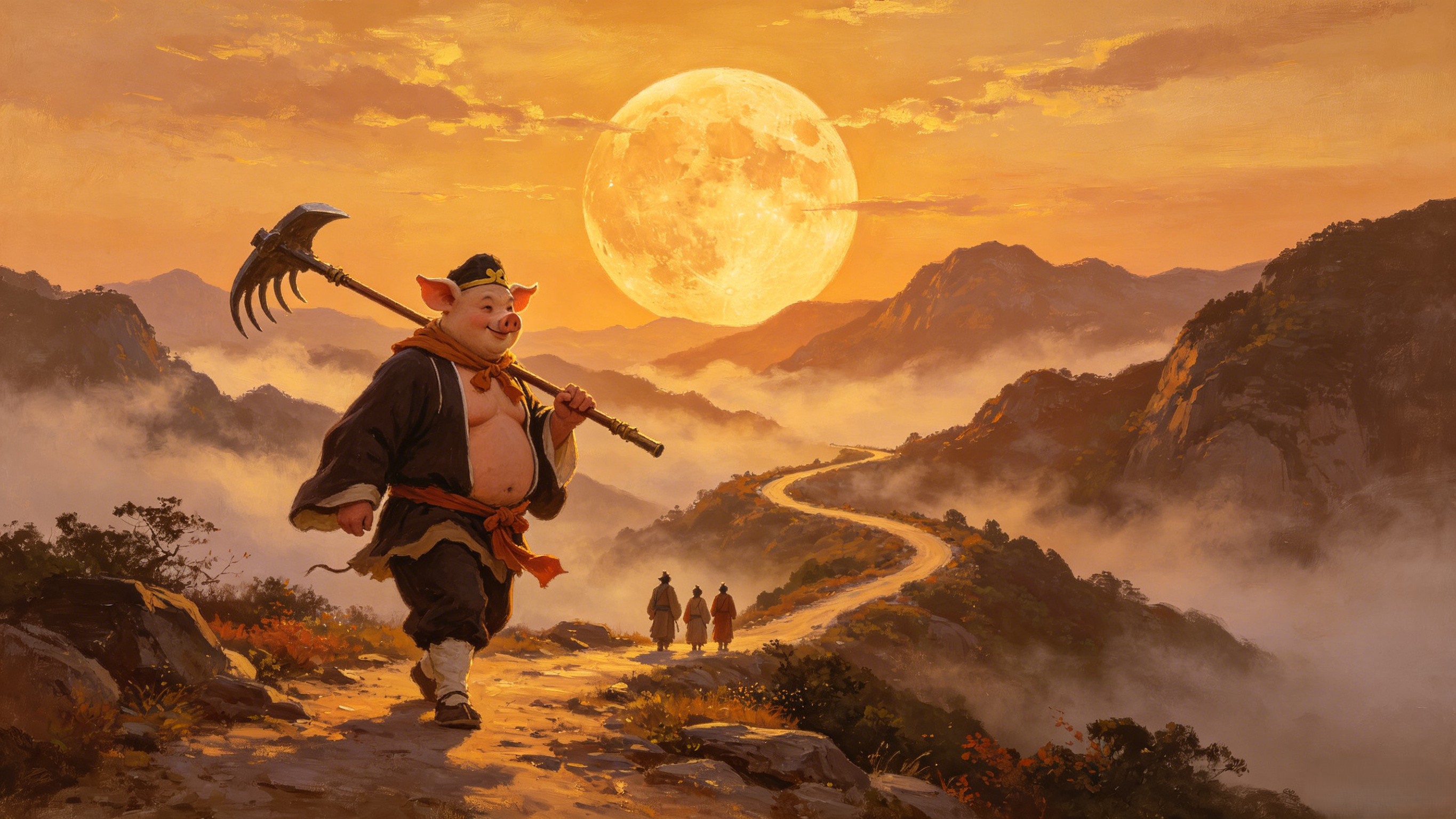
The pilgrim who complained the most, ate the most, ran away the fastest — yet stayed when it mattered. This is why the common people love him best.
Journey & Folk
The pilgrim who complained the most, ate the most, ran away the fastest — yet stayed when it mattered. This is why the common people love him best.
**Zhu Bajie** joined Tang Sanzang's pilgrimage after Guanyin recruited him. Throughout the journey he is the reluctant pilgrim — constantly complaining, threatening to quit, and trying to get Sun Wukong in trouble — yet he always fights when it matters, contributing his immense raw strength and underwater combat prowess.
When Sun Wukong and Tang Sanzang first encountered Zhu Bajie, he was living at Gao Village — having taken a human wife through deception and brute strength. He worked the fields with supernatural endurance, but his true form terrified the household. When Sun Wukong subdued him in combat, Guanyin's promise of redemption was remembered. Zhu Bajie joined the pilgrimage not out of devotion, but survival — yet it was the first step on the longest journey of his life.
On the road west, Zhu Bajie became the embodiment of every human weakness. He hoarded food when others fasted. He ogled women in every village. He suggested giving up at every hardship. He hid during battles, napped through prayers, and tried to run home at least three times. Yet this very excess — this total inability to be anything but his flawed, hungry, frightened self — made him the most beloved character in the pilgrimage. Sun Wukong was the hero you admired. Tang Sanzang was the saint you respected. Zhu Bajie was the one you recognized. He was, in every way that mattered, one of us.
For all his cowardice, Zhu Bajie was no weakling. In the water — his element as a former naval commander — he was arguably more formidable than Sun Wukong. Against river demons, flood dragons, and underwater adversaries, it was Bajie who led the charge. At Tongtian River, against the Jade-Faced Princess, and in countless skirmishes where the battle took to the water, the fallen marshal remembered who he once was. In the right moment, in the right element, the pig became a commander again.
When the scriptures were delivered and the pilgrims received their heavenly rewards, Sun Wukong became the Victorious Fighting Buddha. Tang Sanzang ascended to Buddhahood. Sha Wujing became an Arhat. And Zhu Bajie? He was made the "Cleaner of the Altar" — a divine position whose job was to eat the offerings left at temples. Not a Buddha. Not an Arhat. A job that acknowledged exactly who he was: a being of appetite, transformed into sacred service. He would spend eternity eating — but now, the food was blessed, and his hunger had become part of the cosmic order. No ending in the Journey to the West is more perfectly suited to its character.
In Chinese folk culture, Zhu Bajie is beloved precisely because he is NOT divine. He is the god of appetite, laziness, and relatable weakness — worshipped not despite his flaws, but because of them.
In Journey to the West, Bajie provides the emotional grounding. Sun Wukong is the hero, but Bajie is the heart — his complaints, his hunger, his fear of death, his eventual loyalty. Readers across centuries have seen themselves in him.
In modern Chinese, calling someone a "Zhu Bajie" is both an insult and a term of endearment. He represents the part of human nature that is greedy, lazy, and lustful — but also the part that keeps going, rake in hand, long after heroes have fallen.
Dive Deeper