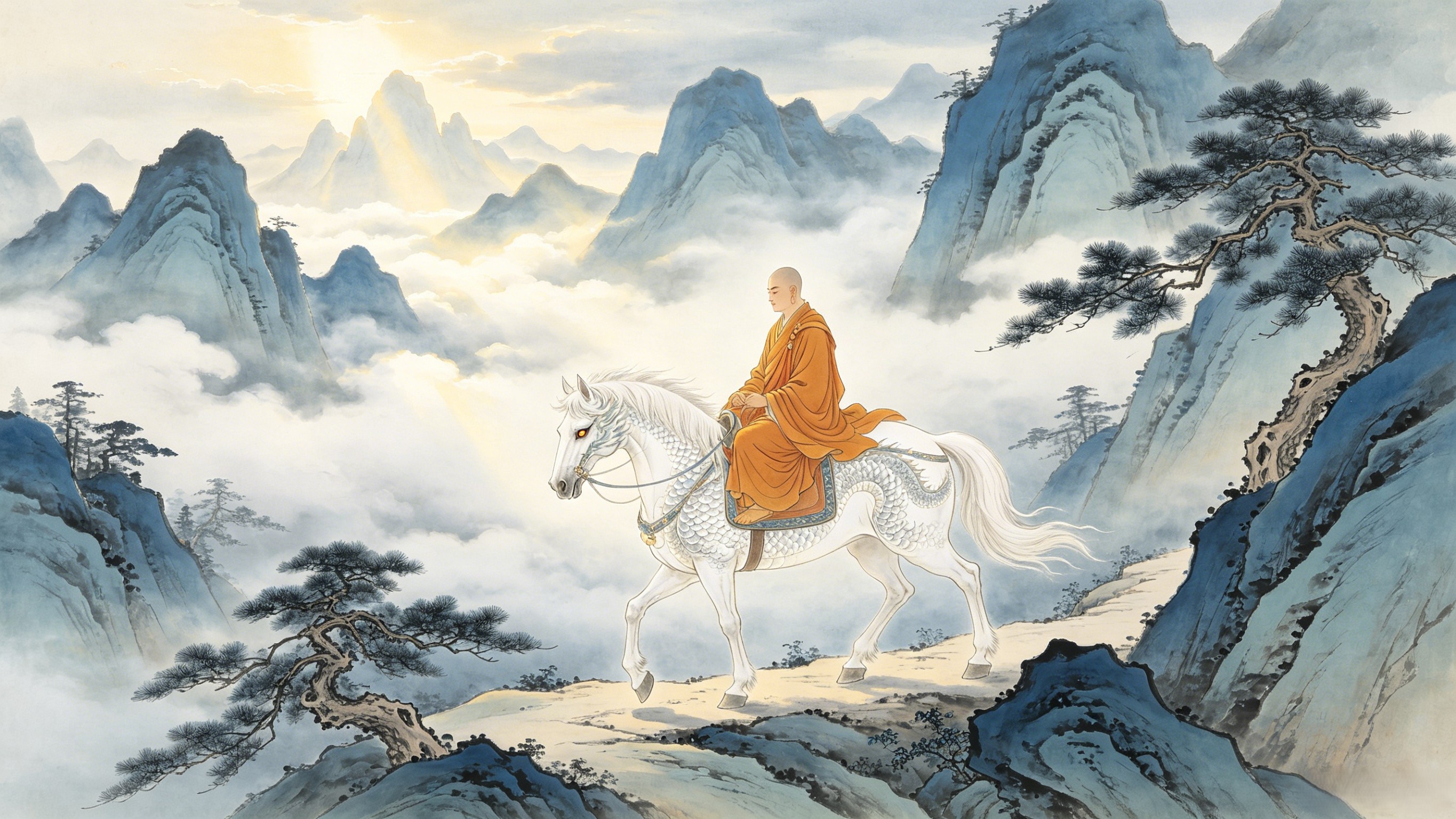
The Journey in Five Phases
I
The First Step — Eagle Grief Stream
The journey began with an act of consumption. Tang Sanzang's original horse — a mortal beast — could never have survived the demon-infested road ahead. So Ao Lie, in dragon form, ate it. When Sun Wukong attacked, Guanyin appeared to reveal the truth: this dragon was no threat. She transformed Ao Lie into a perfect white horse, identical to the one he had devoured. Tang Sanzang climbed onto his new mount's back, and the fifth pilgrim — the one no one counted — took his first step west.
II
The Silent Years — Mountains and Deserts
The pilgrims crossed the Flaming Mountains, where the heat was so intense that mere proximity to the ground would blister a mortal's feet — but the White Dragon Horse carried Tang Sanzang through, his hooves never faltering. They passed through the Kingdom of Women, the Kingdom of Jisai, the Kingdom of Bhiksu. Demons attacked. Wukong fought. Bajie grumbled. Sha Wujing guarded the baggage. And through all of it, the horse walked. On narrow mountain paths where one misstep meant death. Across raging rivers. Through blizzards in the Great Snow Mountains. He never complained. He never resisted. He bore the full weight of the monk — the entire weight of heaven's mission — on his back.
III
The Yellow Robe Demon — His Only Human Form
At Precious Image Kingdom, Tang Sanzang was magically transformed into a tiger by the Yellow Robe Demon. The pilgrims were scattered. Wukong had been temporarily exiled. Bajie was useless. Sha Wujing had been captured. In this moment of absolute crisis, the White Dragon Horse did something he had never done before: he transformed back into human form. As Ao Lie — not a horse, but a dragon prince — he crept into the demon's palace, attempted an assassination, and engaged the Yellow Robe Demon in single combat. Though he was wounded and forced to retreat, his action saved Tang Sanzang's life and bought the time needed for Bajie to convince Wukong to return. Read the full account on the Dragon's Fury page.
IV
The Daily Sacrifice — What Silence Cost
Consider what Ao Lie gave up daily. As a dragon prince, he had commanded the waters of the Western Sea. He had swum through coral palaces. He could transform into any shape and fly through the clouds. As a horse, he ate grass. He stood in the rain. He was tied to trees at night. He was ridden — a creature of celestial rank reduced to a means of transportation. The psychological weight of this transformation must have been crushing. Yet he accepted it. Not once in the entire 14-year journey did Ao Lie attempt to break free, to reclaim his form, or to abandon the pilgrimage. His silence was not weakness. It was discipline.
V
The Final Step — Thunderclap Monastery
When the pilgrims finally reached the Buddha's Thunderclap Monastery on Spirit Mountain, the White Dragon Horse had walked 108,000 li — farther than any of the others. Wukong could somersault. Bajie and Sha Wujing had their demon strength. Tang Sanzang rode. But Ao Lie walked every step of it. At the journey's end, the Buddha himself acknowledged the dragon's service. He was elevated to the rank of Naga Prince, one of the eight classes of celestial dragons — a rank higher than the Dragon Kings themselves. The horse became a dragon again. But he was no longer the same dragon who had burned a pearl in his father's palace.
The Fifth Pilgrim Among Companions
The White Dragon Horse's relationship with each pilgrim was distinct:
Tang Sanzang — The monk he carried. Their bond was physical in the most literal sense: Tang Sanzang's body rested on Ao Lie's back for fourteen years. More than any other pilgrim, Ao Lie was physically indispensable to the journey's success. Without him, the mortal monk could never have survived the terrain.
Sun Wukong — The first to fight him, the first to respect him. Wukong initially attacked the "demon" who ate their horse, but after learning the truth from Guanyin, he became Ao Lie's fiercest defender. Wukong — who chafed at every authority — understood the dragon's silent sacrifice in a way the others didn't.
Zhu Bajie — The former Marshal Canopy, sentenced to banishment for lusting after the Moon Goddess. Bajie was Ao Lie's closest parallel: both were celestial aristocrats brought low. But where Bajie complained constantly, Ao Lie endured silently. Their contrast is deliberate — two fallen nobles, two different responses to suffering.
Sha Wujing — The Sand Monk, another celestial officer who had fallen from grace. Sha Wujing and Ao Lie shared something none of the others did: quiet dignity in service. Neither complained. Neither sought glory. They simply did their duty, day after day, for fourteen years.
14 Years
108,000 Li
81 Tribulations
5 Pilgrims
What the Silent Journey Teaches
In a world that celebrates loudness — the loudest warrior, the boldest speaker, the most visible hero — the White Dragon Horse represents an alternative model of greatness. His contribution was not flashy. It was not celebrated in poetry the way Wukong's battles were. But it was irreplaceable. Without his silent, steady carrying of the monk, there would have been no journey. No scriptures. No redemption for any of them.
The White Dragon Horse reminds us that the most important work is often the quietest. The person who shows up every day. The one who carries the weight without complaint. The one nobody notices until they are gone. In the grand Buddhist cosmology of Journey to the West, where enlightenment is the ultimate goal, Ao Lie's path is perhaps the most instructive: salvation through service. Not through battle. Not through prayer. Through the simple, daily, unglamorous act of carrying someone else's burden.